Jurassic Dinos editorial · Updated · Source-based review
Azendohsaurus was a plant-eating Triassic reptile that once seemed to belong among dinosaurs. More complete fossils changed that interpretation. It is now placed among allokotosaurs, a group of early archosauromorphs outside Dinosauria.
Why did the old identification change?
The Moroccan species, Azendohsaurus laaroussii, was named from teeth and tooth-bearing material in 1972. Early researchers interpreted those limited fossils as dinosaur remains, with different suggestions about which dinosaur group they represented.
Flynn and colleagues described the Madagascan species Azendohsaurus madagaskarensis in 2010. More complete cranial and skeletal evidence showed a combination of features inconsistent with dinosaur identity. Subsequent anatomical and relationship studies placed these animals within Allokotosauria. An early label based on a jaw could therefore be tested against a much broader anatomical picture.
What is convergence?
Convergence is the independent evolution of similar features in different lineages. Azendohsaurus had feeding-related features resembling those of some plant-eating dinosaurs, but that resemblance did not make it a sauropodomorph.
Think of a family tree as a test using many features together. One familiar tooth shape is a useful clue, not a membership card. When more anatomical regions become available, researchers can discover that the original clue was shared independently.
Keep the two species separate
Moroccan laaroussii and Madagascan madagaskarensis are separate species, not two names for one excavated individual. More complete Madagascan material informs the modern understanding of the genus, but it should not be described as a complete skeleton of the original Moroccan specimen.
This page gives the broad Triassic setting without merging uncertain local age assessments into one precise date. It also avoids pooling body measurements between species. The non-dinosaur classification means that Azendohsaurus stays outside our dinosaur-only totals and comparison collections.
What the picture means
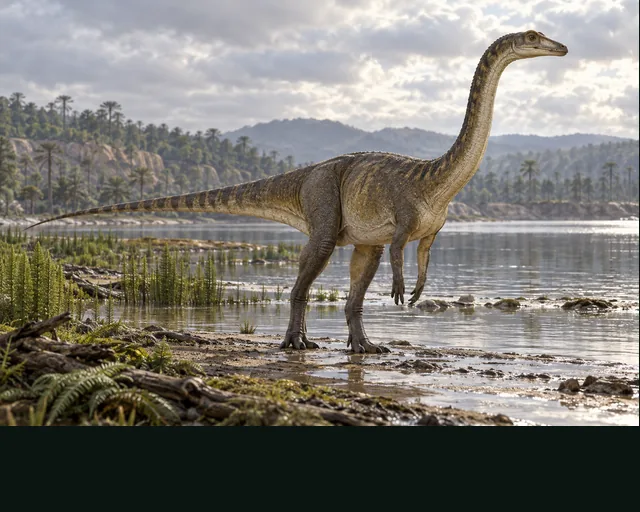
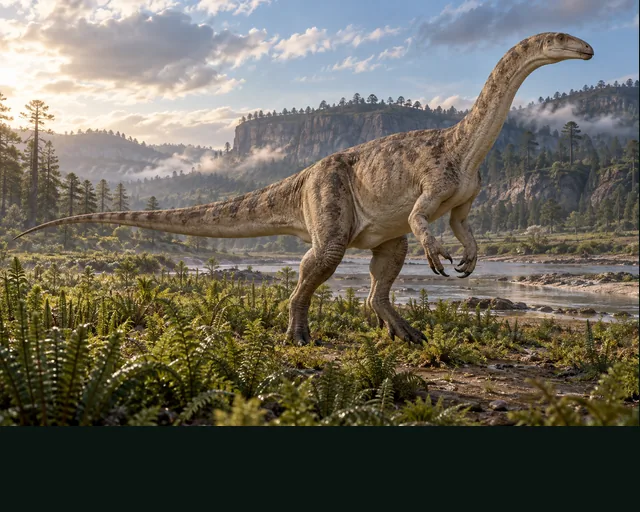
Daeng Dino’s complete named genus-level restoration is our visual reference. It shows a low small head on a curved neck, a stocky quadrupedal torso and a complete tapering tail. The new illustration follows that animal’s visible form. Striping, soft tissues, stance and colours remain artistic interpretations.
The artwork is not a claim that a complete Moroccan body was found, and no dinosaur relative supplies missing structures. Compare Plateosaurus and Massospondylus to see why a general resemblance can be tempting while the evolutionary identity remains different. The A–Z directory includes prehistoric relatives as well as dinosaurs, with the distinction stated rather than hidden in the name.
Quick answers
- Was Azendohsaurus a dinosaur?
- No. More complete material supports an allokotosaurian archosauromorph identity outside Dinosauria.
- Why was it once considered a dinosaur?
- Its limited early jaw and tooth material resembled herbivorous dinosaur anatomy.
- Were Morocco and Madagascar one specimen?
- No. The original Moroccan species laaroussii and Madagascan madagaskarensis are distinct species and fossil records.
- What is convergence?
- It is the independent evolution of similar features in different lineages, rather than inheritance from an immediate shared ancestor with that feature.