Jurassic Dinos editorial · Updated · Source-based review
Austroposeidon magnificus was a large titanosaur from Late Cretaceous Brazil. Its name evokes a powerful giant, but the science rests on incomplete vertebrae rather than a complete towering skeleton. That distinction makes this animal useful for understanding how size estimates and anatomical diagnoses answer different questions.
What was actually found?
Bandeira and colleagues described Austroposeidon in 2016. The type specimen, MCT 1628-R, includes incomplete neck vertebrae, a neck rib, back vertebral material and a sacral fragment. The sacrum is the part of the spine associated with the pelvis.
The study refers the fossil to the Presidente Prudente Formation near the city of the same name in São Paulo state. It also discusses preservation damage. A feature affected by compression or breakage has to be evaluated carefully rather than copied uncritically into a reconstruction.
How can limited bones identify a giant?
The researchers compared combinations of vertebral features with other titanosaurs. A diagnosis is about distinguishing anatomy, not merely being bigger than a familiar animal. Large size alone would not establish a separate genus.
The authors estimated a total length of about 25 metres and interpreted the individual as adult. Those are research interpretations with limits. The number is not a tape measurement of a complete preserved body, and adult status does not reveal an exact age in years. We do not add an unsupported mass alongside it.
Why examine the inside of a vertebra?
The study used CT scanning to investigate internal structure. CT builds views through an object without cutting the whole specimen apart. Internal spaces can provide information that an external photograph cannot show.
Such scans are evidence for anatomical research. They are not a complete-body visual reference, and they do not establish skin colour or the exact outline of missing limbs. Our illustration workflow keeps that boundary clear.
A complete image with explicit limits
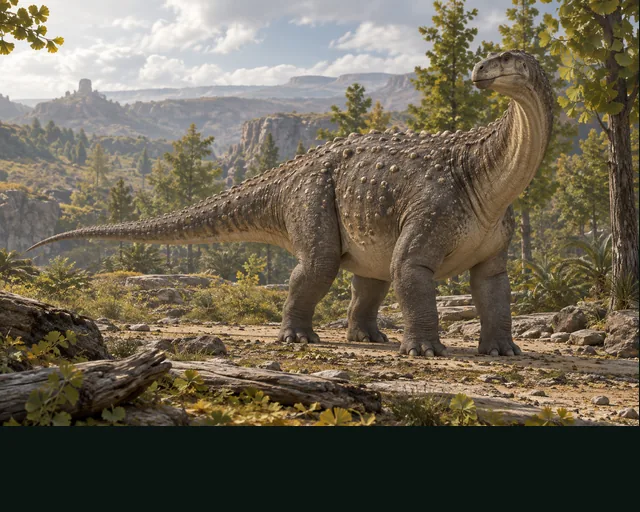
Levi Martinez-Reza’s named, complete living restoration supplies the visible form: a small head on a very tall sloping neck, a broad body, four long supporting limbs and a long tapering tail. The new scene follows that whole artwork. Neck posture, soft tissues and colours remain interpretations.
The original paper’s national size comparison was made in 2016; it is not repeated as an unchanging record. Compare Argentinosaurus and Saltasaurus for other titanosaur discoveries, then explore the A–Z directory. A giant’s scientific value lies in what its fossils reveal, not just its position on a size chart.
Quick answers
- What was found?
- Incomplete neck, back and sacral vertebral material and a neck rib, not a complete skeleton.
- How long was Austroposeidon?
- The 2016 authors estimated roughly 25 metres; this is a reconstruction-based estimate, not a measured complete animal.
- Where did it live?
- In Late Cretaceous southeastern Brazil, represented by the Presidente Prudente Formation.
- Is it definitely Brazil’s largest dinosaur today?
- That was the original paper’s dated comparison. This page does not treat a changing national size record as a permanent fact.