Jurassic Dinos editorial · Updated · Source-based review
Atsinganosaurus velauciensis was a titanosaur from the Late Cretaceous of southern France. Its fossils come from Velaux-La Bastide Neuve in Provence. This sauropod is especially useful for asking how scientists combine discoveries from several individuals without pretending they found one perfect skeleton.
What was preserved?
A 2018 anatomical study described additional remains from the type locality and horizon. It identifies the setting as upper Campanian rocks of the Argiles et Grès à Reptiles Formation. The material includes skull fragments and teeth, vertebrae and ribs, and parts of the shoulder region and limbs.
The researchers identified at least three individuals. That number matters: an inventory containing many body regions is not necessarily one animal preserved from nose to tail. Scientists must track specimen identities and compare size and anatomy before deciding how material relates.
Why study more than one individual?
Multiple specimens can reveal variation that a single fossil would hide. An apparent difference could reflect growth, preservation or variation within a species rather than a separate genus. Comparing material also helps check whether an original diagnosis still works when new bones become available.
This is why a scientifically useful discovery need not produce a completely different-looking animal. Small anatomical observations can clarify relationships even when popular illustrations retain a familiar long-necked silhouette.
Was it an island dwarf?
A 2018 conference abstract by Jentgen and colleagues examined long-bone tissue from mature individuals. It proposed island dwarfism as a consistent explanation for the combination of relatively small size and mature bone structure. Histology means studying tissue at a microscopic level.
That proposal is an evidence-based hypothesis, not a fact demonstrated by a tiny animal in a painting. Mature bone structure also does not reveal an exact age in birthdays. We identify the conference nature of the source and avoid turning its interpretation into an unsupported numerical length or mass.
Reading the restoration
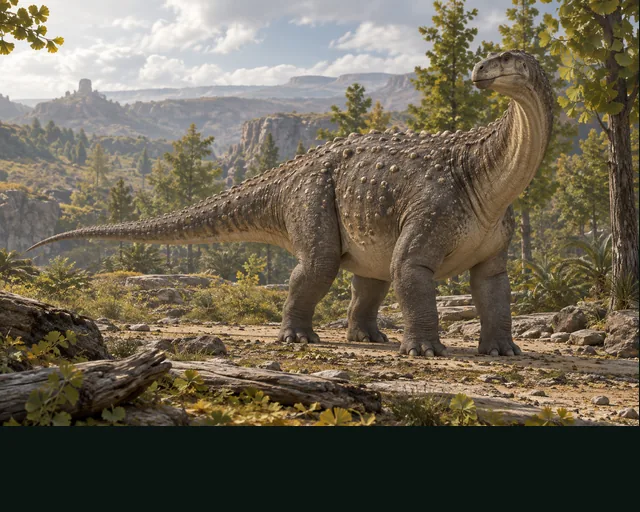
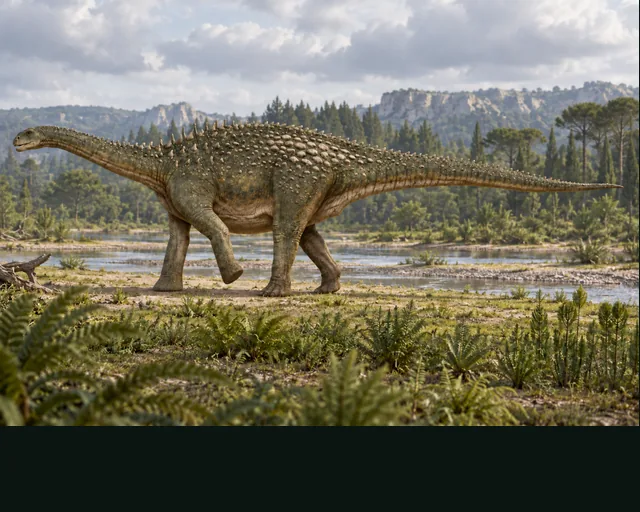
Our visual reference is Levi Bernardo’s complete named living restoration, showing a small head, long low neck, broad trunk, four columnar legs and a long tail with a low dorsal ridge. Fine skin, ridge detail, colours and full-body proportions remain interpretive. The new scene follows that whole image rather than constructing missing anatomy from bones.
Compare Ampelosaurus and Saltasaurus for other titanosaur accounts, then return to the A–Z directory. Differences in fossil completeness, growth evidence and setting are often more informative than a dramatic size ranking.
Quick answers
- Where did Atsinganosaurus live?
- In what is now southern France; its type locality is Velaux-La Bastide Neuve in Provence.
- Do all described bones belong to one animal?
- No. The 2018 anatomical study describes material representing at least three individuals.
- Could a small fossil simply be a baby?
- Sometimes, but researchers can examine bone tissue for evidence of maturity instead of assuming age from size alone.
- Is island dwarfism proved by its picture?
- No. That hypothesis comes from evidence such as maturity and comparative size, not from an artwork.