Jurassic Dinos editorial · Updated · Source-based review
Atacamatitan chilensis was a titanosaur sauropod from northern Chile. Its remains were collected in the Tolar Formation in the Antofagasta Region, within the modern Atacama Desert. The name invites a desert scene, but a modern place name is not a photograph of a Cretaceous ecosystem.
What did researchers describe?
Kellner and colleagues named the animal in 2011. Their original description concerns a partial skeleton, with material including back and tail vertebrae, part of an upper arm bone and a thigh bone. It is not a complete head-to-tail skeleton.
The Museo Nacional de Historia Natural’s announcement explains that particular features of the vertebrae and femur helped distinguish the new species. A femur is the upper hind-limb bone. Comparing it with other titanosaurs can reveal differences even when a skull is missing. Important discoveries are not limited to fossils that would make a complete museum mount.
What does it tell us about the rocks?
The original paper discusses how the titanosaur material supports a Cretaceous age for the relevant Tolar outcrops, whose age had previously been uncertain. Fossils can help test geological interpretations as well as reveal animals.
We use the study’s Late Cretaceous setting without turning a rounded age in a public announcement into an exact date. Similarly, a claim that a specimen was among the most complete regional finds in 2011 should retain its historical date. New discoveries can change a completeness record; the specimen itself remains useful.
What might it have eaten?
Titanosaurs were plant-eating sauropods. That broad interpretation does not identify an individual meal. The museum announcement suggests araucarias as food, but this page does not turn a proposed plant choice into a demonstrated favourite.
A fossil’s current location also does not prove that Atacamatitan had the adaptations of an animal living in today’s exceptionally dry desert. Ancient environments require geological and biological evidence, rather than assumptions drawn from a modern map.
Our whole-body reference
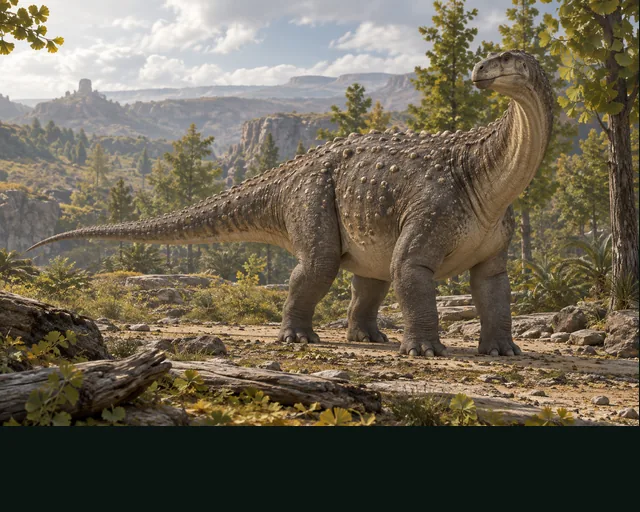
Levi Bernardo’s named complete restoration supplies the visible form for the new illustration: a small head on a long raised neck, a heavy four-legged trunk and a narrow tapering tail. Skin detail, colours and full-body proportions remain artistic interpretations. We follow the living restoration, never build missing anatomy from the fossil photographs.
Compare Saltasaurus and Argentinosaurus for other titanosaur discoveries. The A–Z directory offers more examples of how fragmentary evidence can still support a carefully qualified animal account.
Quick answers
- Where was Atacamatitan found?
- In the Tolar Formation of northern Chile’s Antofagasta Region, in today’s Atacama Desert.
- Was its skull discovered?
- The original abstract describes vertebrae and limb material, not a complete skull or whole skeleton.
- Did it live in today’s desert?
- It lived in the Cretaceous landscape of that region; the modern desert name does not establish the ancient habitat.
- Was it a plant eater?
- It is interpreted as a herbivorous titanosaur, but a specific favourite plant is not established here.