Jurassic Dinos editorial · Updated · Source-based review
Arrudatitan maximus was a plant-eating titanosaur from Late Cretaceous Brazil. Titanosaurs are part of Sauropoda, the long-necked dinosaur group. This animal is especially useful for understanding an easily confused idea: scientists can change the genus attached to a fossil species without discovering an entirely new skeleton.
Why did its name change?
The species was originally described as Aeolosaurus maximus. Silva Junior and colleagues reassessed its anatomy and evolutionary relationships, publishing their work online in 2021 and in a 2022 journal volume. They proposed the genus Arrudatitan because the Brazilian animal’s relationship to Argentine Aeolosaurus was uncertain and its diagnostic anatomy supported a separate name.
A genus is one level in the naming system; maximus is the species part of the name. Reassigning this species does not turn all Aeolosaurus fossils into Arrudatitan. It is rather like correcting one folder’s label after checking its contents, rather than renaming the whole filing cabinet.
Where does the evidence come from?
The reassessment places the type locality in the Adamantina Formation in São Paulo state. Here, a formation means a named package of rock layers. A caption accompanying the artwork gives a different formation, but an illustration caption does not outweigh the original fossil study. We use the primary research’s locality and avoid assigning a narrow numerical age from the picture.
The University of São Paulo thesis record independently documents the research project and its reassessment of this Brazilian titanosaur. It also explains why the relationships of Brazil’s many titanosaurs require further work. A branching family tree is a tested hypothesis, not a list permanently settled by a familiar silhouette.
Reading the whole-body illustration
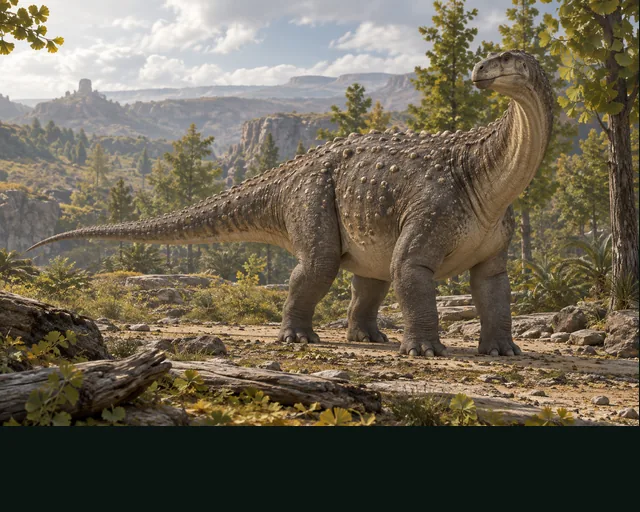
Our visual reference is LancianIdolatry’s complete restoration specifically labelled Arrudatitan maximus. It shows a small head on an extremely long raised neck, a heavy four-legged trunk and a long tapering tail. The new cinematic scene follows those visible proportions. It does not borrow another Aeolosaurus species as its model.
Neck posture, skin texture and colour remain artistic choices. The painting does not prove a preferred feeding height, social behaviour or an exact maximum size. We therefore keep unsupported length and mass values out of the facts panel.
Compare related giants
Visit Argentinosaurus and Saltasaurus for other titanosaur stories. Similar membership does not make their measurements interchangeable. Return to the A–Z directory to follow more names whose histories reveal how palaeontology revises its ideas.
Quick answers
- What was Arrudatitan called before?
- Its species was originally named Aeolosaurus maximus; it is now placed in Arrudatitan.
- Did all Aeolosaurus become Arrudatitan?
- No. The reassignment concerns the Brazilian species maximus, not every species of Aeolosaurus.
- Where did it live?
- In Late Cretaceous southeastern Brazil; the reassessment identifies the type locality within the Adamantina Formation.
- Why do sources give 2021 and 2022?
- The reassessment was published online in 2021 and appeared in a 2022 journal volume.