Jurassic Dinos editorial · Updated · Source-based review
Argyrosaurus was a titanosaurian sauropod from Argentina. It is one of the early names in the history of Patagonian dinosaur research, yet its defining fossil does not preserve the complete giant shown in a restoration. The animal’s identity is anchored by a forelimb.
An old name and a limited specimen
Richard Lydekker named Argyrosaurus superbus in 1893. The defining material includes the complete forelimb rather than a skull, every vertebra and all four legs. It belongs to the Late Cretaceous record of Patagonia, but this page does not turn uncertain historical provenance into an exact numerical age.
A type specimen anchors a scientific name. Other bones can later be referred to that animal if diagnostic comparisons support the identification. Finding a large sauropod bone in the same broad region is not sufficient by itself, especially when several related dinosaurs lived there at different times.
Sorting the referrals
Philip Mannion and Alejandro Otero reassessed Argyrosaurus in 2012. They examined the defining forelimb and evaluated material previously assigned to the genus. Their work restricted confident identification and separated an informative partial skeleton into another genus, Elaltitan.
This does not mean that Argyrosaurus itself was simply renamed Elaltitan. The two names are anchored by different specimens. Moving one referred skeleton out of a genus can improve the definition of both animals, even if it makes an older reconstruction less complete.
Think of sorting a collection of puzzle pieces whose boxes have been mixed. A piece that fits one box’s general colour is not automatically part of that puzzle. In palaeontology, researchers need anatomical matches, documentation and a careful account of what remains uncertain.
Why the arm is still useful
Forelimb bones preserve shapes, proportions and joint structures that can be compared with other titanosaurs. They can help identify an animal and investigate relationships without revealing its entire head, neck or skin. The absence of those regions is a reason to qualify a reconstruction, not to borrow another named dinosaur’s complete skeleton unnoticed.
A broad plant-eating interpretation follows its sauropod relationships. A detailed menu, feeding height or exact body mass is not established by this forelimb alone.
A clearly labelled whole animal
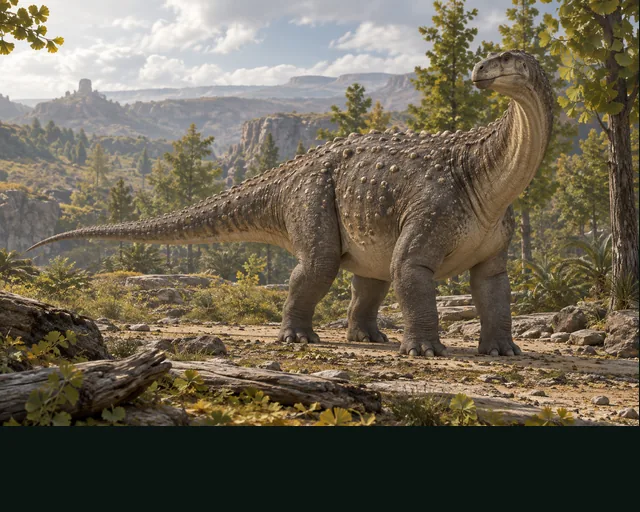
Our illustration follows FunkMonk’s complete Argyrosaurus restoration. Its tall curved neck, broad torso, thick supporting limbs and long curving tail follow that named artwork. The source artist used comparative reconstruction for missing regions, so the full body and colours remain interpretive. The picture is not a portrait of the separate Elaltitan specimen.
Compare Argentinosaurus and Saltasaurus, or browse A–Z under A.
Quick answers
- What anchors the name Argyrosaurus?
- The defining specimen is a complete forelimb, rather than a complete head-to-tail skeleton.
- Was Elaltitan simply a new name for Argyrosaurus?
- No. It was named for a different specimen previously referred to Argyrosaurus.
- Are all historical referrals equally secure?
- No. The 2012 revision restricted confident identification to the defining material.
- Does the artwork establish its exact size?
- No. A full-body artistic restoration is not an independently measured whole skeleton.