Jurassic Dinos editorial · Updated · Source-based review
Ardetosaurus was a long-necked, plant-eating sauropod from Late Jurassic Wyoming. Its name tells two stories at once: one about a dinosaur, and another about what happened to its fossils millions of years later. Keeping those stories separate is part of understanding the evidence.
A specimen with a journey
Tom van der Linden and colleagues named Ardetosaurus viator in 2024. The defining specimen, MAB011899, came from the Howe-Stephens Quarry in the Morrison Formation. After excavation, the material travelled through several European collections and preparation facilities before reaching the Oertijdmuseum in the Netherlands.
Some bones were damaged or destroyed in a modern museum fire. The name’s burning reference commemorates that fossil history, while viator refers to travel. It does not imply that the living animal survived a wildfire, had fiery colours or possessed special heat resistance.
The study also explains that a completed museum mount combines bones from more than one individual. That distinction is important: a spectacular continuous skeleton on display is not automatically one equally complete fossil specimen.
How was a new dinosaur recognised?
The authors compared the surviving material with other diplodocines, the sauropod branch containing Diplodocus and several relatives. Their diagnosis involved ridges and hollows on vertebrae, together with other anatomical characters. Such small details can distinguish animals with broadly similar long-necked silhouettes.
A ridge on a vertebra is not the same thing as a visible skin ridge on a living dinosaur. Many diagnostic features would have been covered by muscles and other tissues. Identifying a genus and reconstructing its external appearance therefore require different kinds of evidence.
Why collection records matter
Maps, photographs and labels help researchers follow individual bones through excavation, preparation and damage. If pieces from several animals are nearby, a missing label can make an assignment uncertain even when the bone itself survives.
The Ardetosaurus study interpreted its specimen as skeletally mature. That conclusion comes from anatomical and growth evidence, not from assuming that every large sauropod bone belonged to a fully grown animal. This page does not turn estimated growth ages into an exact birthday.
Our illustration
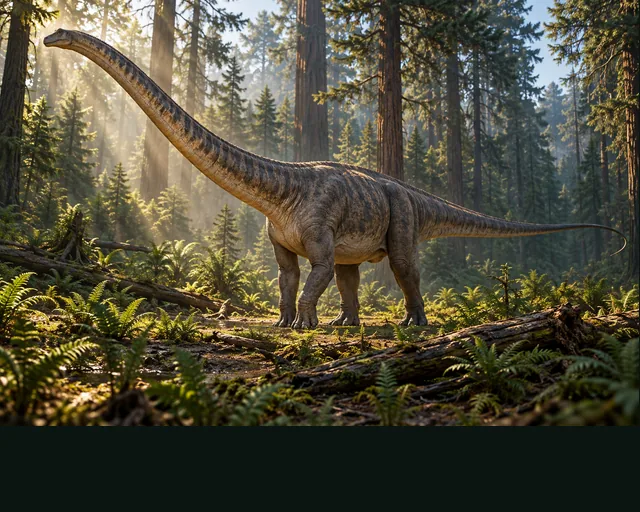
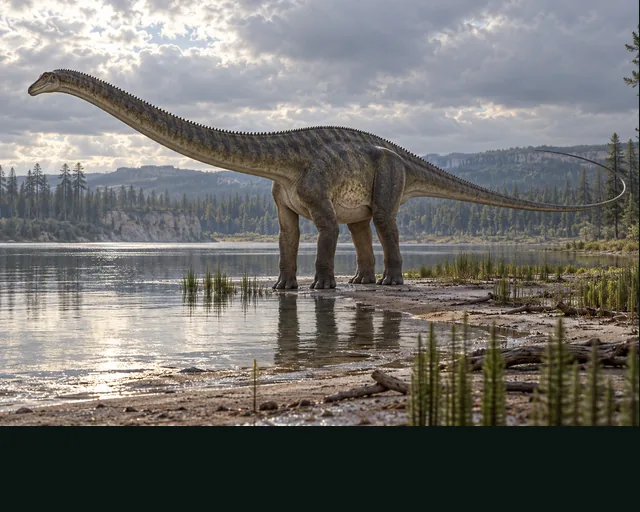
The image follows Ddinodan’s complete Ardetosaurus restoration, with a small head, raised long neck, four supporting legs and an exceptionally long thin tail. Posture, full soft-tissue outline and colour remain artistic interpretations. The fossil’s fire damage is not painted as a wound on the living animal.
Compare Diplodocus and Barosaurus, or explore A–Z under A.
Quick answers
- Where did Ardetosaurus live?
- Its fossils come from the Late Jurassic Morrison Formation at Howe-Stephens Quarry in Wyoming.
- Does its name mean it lived in flames?
- No. The burning reference concerns a modern fire that damaged its fossil material.
- Was the displayed composite one complete individual?
- No. The described museum mount combines material from more than one individual.
- How was it distinguished from familiar diplodocines?
- Researchers compared combinations of vertebral ridges, hollows and other anatomical features.