Jurassic Dinos editorial · Updated · Source-based review
Arcusaurus was an early sauropodomorph dinosaur from South Africa. Sauropodomorphs include the ancestors and relatives of the later giant sauropods, but many early members had very different proportions. Arcusaurus also offers a lesson about young fossils and evolutionary history that has not yet been sampled by discoveries.
A rainbow name
Adam Yates, Matthew Bonnan and Johann Neveling named Arcusaurus pereirabdalorum in 2011. The genus refers to South Africa as the Rainbow Nation. The species name honours Lucille Pereira and Fernando Abdala, who helped uncover the material.
The fossils came from the upper Elliot Formation in the Senekal district of the Free State, in Early Jurassic rocks. The original study described a partial, disarticulated skull and scattered skull and body elements representing at least two individuals. “Disarticulated” means that the bones were no longer joined in their living arrangement.
How did the researchers recognise young animals?
Bonnan’s first-hand account explains that the material was incomplete and interpreted as juvenile. The reasoning involved anatomy as well as small size. Some structures that normally join during growth were not fused, and their surfaces suggested separation after death rather than simply a fresh break in an adult bone.
This distinction matters when interpreting a small dinosaur. A juvenile specimen cannot automatically supply the maximum size, adult skull shape or final body proportions of its species. A whole-animal picture may look convincing while those questions remain unanswered.
The original description identified distinguishing features in skull bones and the far end of the tail. These comparisons support a separate taxon without requiring a perfectly preserved skeleton.
A gap on an evolutionary tree
Researchers use anatomical comparisons to propose where Arcusaurus fits among early sauropodomorphs. If close relatives are known from much older rocks, their relationship can imply an unsampled interval of history. This is often called a ghost lineage.
A ghost lineage is an inference. It does not mean that palaeontologists have found an invisible animal or recovered fossils from every year in the gap. Its length also depends on the proposed evolutionary relationships, which remain open to testing.
Our restoration
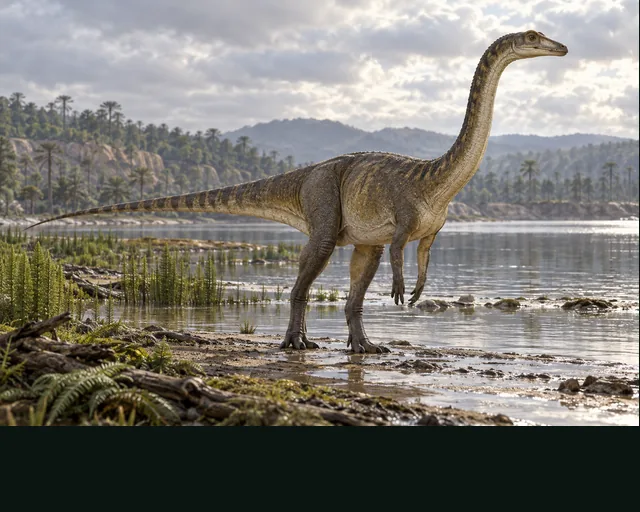
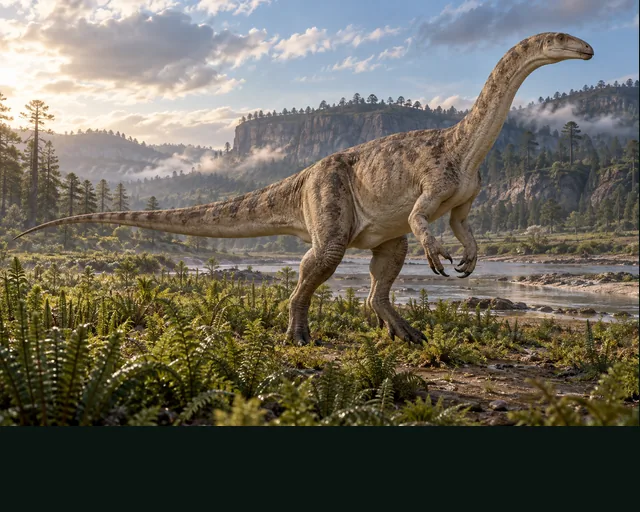
The image follows Levi Bernardo’s complete Arcusaurus living-outline drawing: a small head on a long narrow neck, short forelimbs, longer hind limbs and a thin extended tail. Missing body proportions, fine skin and colours are interpretations. The project does not infer them directly from isolated skeletal pieces.
Compare Plateosaurus and Massospondylus, or explore A–Z under A.
Quick answers
- What kind of dinosaur was Arcusaurus?
- An early sauropodomorph, part of the broader radiation that also includes later giant sauropods.
- Where was it found?
- In the upper Elliot Formation of South Africa’s Free State.
- Were the specimens fully grown?
- The researchers interpreted the available material as juvenile, using anatomy and fusion rather than size alone.
- What is a ghost lineage?
- An inferred interval of evolutionary history without a directly sampled fossil, not an extra specimen that has been found.