Jurassic Dinos editorial · Updated · Source-based review
Archaeocursor was a small dinosaur from Early Jurassic China, described from a single thigh bone. That limited fossil can still carry several kinds of information, but it cannot supply everything shown in a complete animal illustration. Its story is a good example of how scientists extract useful clues while keeping uncertainty visible.
One bone, several questions
Xiang Yao and colleagues described Archaeocursor asiaticus in a study issued in 2025. Its geological context lies in the Ziliujing Formation of southwestern China. The defining fossil is a femur, the bone between the hip and knee.
Researchers compare projections, joint surfaces and proportions to investigate the owner’s relationships. They can also examine microscopic tissue inside the bone. These approaches address different questions: anatomical comparison helps with identity, while growth patterns can help estimate maturity.
The study interpreted the individual as a young adult. This matters because a small bone might otherwise be assumed to represent a baby of a much larger dinosaur. The authors’ approximately one-metre body-length estimate remains a reconstruction, not a measurement taken along a complete skeleton. We do not convert it into an exact comparison value.
Why the discovery mattered
The original paper described Archaeocursor as extending the known record of early ornithischians in East Asia. Ornithischia is one of the major dinosaur radiations, including armoured dinosaurs, ceratopsians and many beaked plant eaters.
The authors recovered Archaeocursor as an especially early-diverging Asian member of that radiation, but explicitly reported weak support for its placement. “Oldest known” and “earliest branching” are also different ideas: one concerns fossil age, the other an inferred position on an evolutionary tree. Neither should become a permanent headline immune to new discoveries.
The paper discussed possible links with Gondwanan forms and dispersal into northern landmasses. That is a hypothesis about population history, not evidence that this particular individual completed a journey between continents.
Limits of the picture
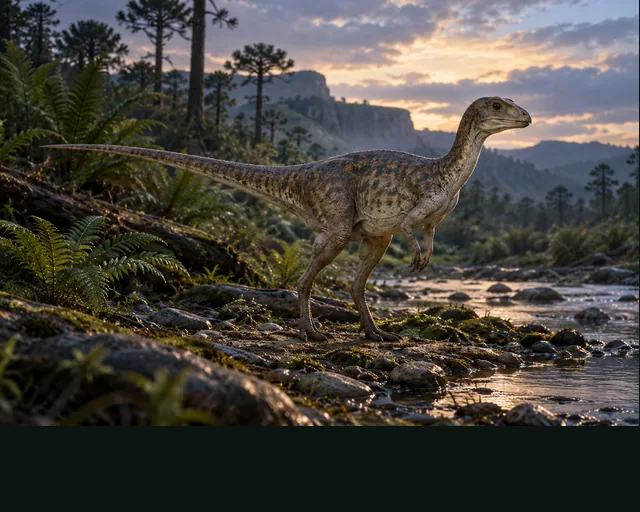
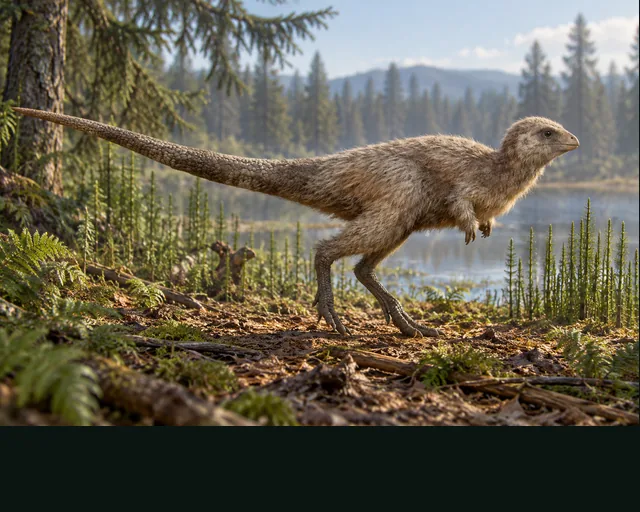
Our illustration follows Ddinodan’s complete named Archaeocursor restoration. It retains the small elongated head, very short arms, long hind legs and straight tapering tail in that work. The covering, colours and most body proportions are highly interpretive. We do not create a whole body directly from the isolated femur or borrow a relative’s portrait.
The bone also does not reveal a precise daily menu, so the diet category remains uncertain here.
Keep exploring
Compare Lesothosaurus and Kulindadromeus for other ornithischian stories, or visit A–Z under A.
Quick answers
- What fossil is Archaeocursor based on?
- A single femur, the upper bone of the hind leg.
- Was it a baby dinosaur?
- The study interpreted its bone tissue as that of a young adult, rather than assuming small size meant infancy.
- Is its exact position secure?
- The original paper explicitly reported weak support for its early-branching ornithischian placement.
- Was the whole feathered body preserved?
- No. Our whole-animal image follows a named artist restoration and is highly interpretive.