
Jurassic Dinos editorial · Updated · Source-based review
Apatoraptor was a feathered, bird-like dinosaur from Alberta, Canada. Its discovery involved a long case of mistaken identity, followed by careful preparation and comparison. The evidence also makes it a useful reminder that feathers and flight are different questions.
A specimen waiting for another look
The skeleton was found in 1993 in rocks of the Horseshoe Canyon Formation. It was initially identified as an ornithomimid, one of the ostrich-like theropods. Later preparation revealed that this first identification did not explain the specimen’s anatomy.
Gregory Funston and Philip Currie named Apatoraptor pennatus in 2016 and placed it among caenagnathids. Caenagnathidae is one branch of Oviraptorosauria, a group containing many beaked, bird-like theropods. The discovery shows why museum collections matter: a fossil can provide new information long after its first excavation.
An initial label is a working hypothesis. Preparation may expose features that were hidden in rock, and comparisons may improve as researchers study additional specimens. Changing the identification through evidence is part of the scientific process rather than a failure of that process.
What do feather scars tell us?
Researchers identified quill-attachment marks on the ulna, one of the forearm bones. Such structures support the presence of substantial feathers attached along the arm. They are more direct evidence than simply deciding that a dinosaur looks bird-like.
They do not reveal the complete outline, colour or pattern of every feather. A mark where a feather attached is not the feather itself. The University of Alberta’s discovery account explained that Apatoraptor could not have used these feathered arms for flight.
Feathers can serve purposes beyond flying, including visual communication and covering the body. A proposed display role remains an interpretation, however. It does not identify this individual’s sex or demonstrate a particular courtship routine.
How much of its daily life is known?
Its caenagnathid relationships help frame questions about feeding and behaviour, but a beaked head does not by itself supply a precise menu. This page leaves the diet category uncertain rather than choosing an unsupported list of foods or a dramatic predatory scene.
Reading the artwork
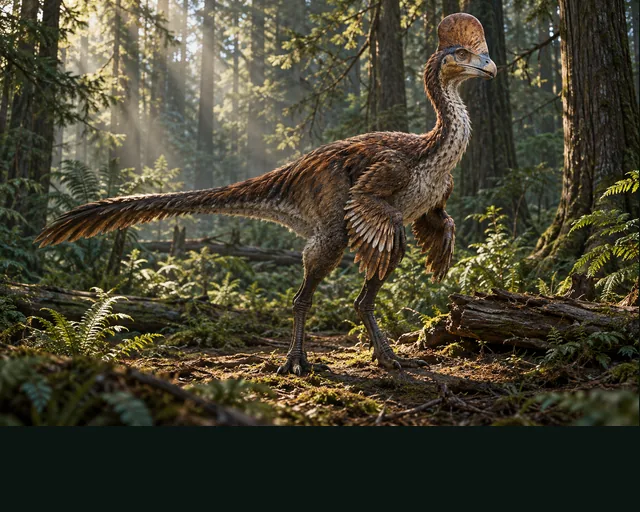
Our image follows Nobu Tamura’s complete Apatoraptor restoration, with a short beaked head, long feathered neck, feathered forelimbs, long legs and a short feathered tail. The source’s crest, full plumage and colours are artistic interpretations. They should be distinguished from the arm’s actual feather-attachment evidence.
Compare Anzu and Oviraptor, or browse A–Z under A.
Quick answers
- What group did Apatoraptor belong to?
- Caenagnathidae, a branch of oviraptorosaur theropods.
- What indicates feathers on its arms?
- Quill-attachment marks on the ulna support the presence of substantial arm feathers.
- Could it fly?
- The feathered-arm interpretation does not imply flight; the researchers described it as flightless.
- Do feather scars reveal exact plumage colour?
- No. The complete covering, crest and colours in the restoration remain artistic interpretations.
![Nobu Tamura email:[email protected] https://spinops.blogspot.com/ https://paleoexhibit.blogspot.com/](https://commons.wikimedia.org/wiki/File:Apatoraptor_NT_small.jpg)