Jurassic Dinos editorial · Updated · Source-based review
Aorun was a Jurassic theropod dinosaur from Xinjiang in northwestern China. Its known specimen was very young, which makes it valuable for studying dinosaur growth and surprisingly challenging for interpreting relationships. A small fossil animal is not necessarily the adult of a small species.
A leg led to a skull
James Clark, Jonah Choiniere and their colleagues discovered the remains in 2006. According to George Washington University’s account, a small exposed part of the leg led to the discovery of a skull, lower jaw and partial skeleton in the surrounding rock. The fossils came from the Shishugou Formation.
The formal study appeared online in 2013 and in a journal volume dated 2014. The researchers named Aorun zhaoi after a Dragon King in the Chinese story Journey to the West. This literary connection supplies a memorable name, not evidence that the animal had mythical powers or a dragon-like crest.
How young was it?
Microscopic bone structure indicated that the known individual was no more than about a year old. Histology examines tissue patterns rather than simply judging age from the skeleton’s overall length. As animals grow, some features change shape or fuse, so a juvenile can differ substantially from an adult of its own species.
The small, numerous teeth support a meat-eating interpretation involving small prey. They do not preserve an actual meal. Likewise, dimensions of this young specimen should not be presented as a securely known adult maximum.
Why do researchers debate its relatives?
The original study placed Aorun among early coelurosaurs and tested whether removing growth-sensitive characters changed that conclusion. A later analysis by Andrea Cau in 2024 used a different approach to handling growth stages and recovered Aorun among early allosauroids instead.
These are competing evolutionary hypotheses. The later result is not a reason to declare every earlier anatomical observation wrong, nor should the earlier label be treated as permanently settled. Researchers must examine how characters are recorded, which specimens are sampled and how juvenile anatomy affects the comparison.
The image is a restoration
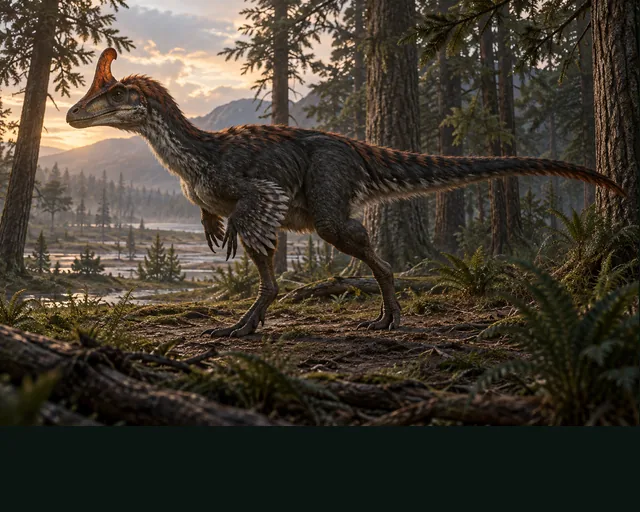
Our illustration follows J-H. Jang’s complete Aorun artwork, retaining its small head, curved neck, grasping forelimbs, long legs and slender tail. The artist’s covering and whole-body proportions are interpretations, not a preserved complete coat or a reconstruction of a measured adult.
Compare Guanlong and Allosaurus for other theropod stories, or continue exploring A–Z under A.
Quick answers
- Where was Aorun found?
- In the Jurassic Shishugou Formation of Xinjiang, China.
- Was the known animal an adult?
- No. The original histological study interpreted it as no more than about one year old.
- Was its adult size tiny?
- That cannot be established by simply treating the young specimen as fully grown.
- Is its exact evolutionary position settled?
- No. The original coelurosaur result and a later allosauroid analysis illustrate competing hypotheses.