Jurassic Dinos editorial · Updated · Source-based review
Animantarx was an armoured, plant-eating dinosaur from Utah. Its discovery is memorable because survey equipment helped locate buried fossils before obvious bones were exposed. Its name means “living fortress”, but neither that nickname nor a dramatic restoration means that every piece of its armour is known.
Finding what the eye could not see
Ramal Jones used a sensitive radiological survey at the Carol site. Fossil bones in this setting can carry a slightly different radiation signal from the surrounding material. Detecting that signal helped guide the search underground, according to accounts from the Utah Geological Survey and the Prehistoric Museum.
This does not mean that the living dinosaur had a radioactive superpower. Fossils have a long history after death, including interactions with minerals and groundwater. Equipment measures the material that survives today, not a magical property of the original animal.
What the fossils preserve
Kenneth Carpenter and colleagues named Animantarx ramaljonesi in 1999. The material comes from the Mussentuchit Member of the Cedar Mountain Formation. The museum describes parts of the lower jaw, rear skull, neck and back vertebrae, and front and hind limbs.
The original description highlighted features of the domed skull and relatively small horns behind the eye region, together with details of the shoulder and thigh bones. These anatomical characters help distinguish a dinosaur even when its complete outline is missing.
The museum handout also explains that missing parts of its mounted skeleton were modelled. A completed display is a valuable educational tool, but a viewer should distinguish original fossil evidence from reconstructed portions.
Armour without a club
Animantarx is generally interpreted as a nodosaurid ankylosaur. Nodosaurids belong within the broader armoured dinosaur radiation, but they lack the large terminal tail club familiar in many ankylosaurids. The museum interprets Animantarx as a plant eater through its relationships and anatomy, while noting that its teeth are not preserved.
That is an inference with a stated basis, rather than a claim to have found its last meal. Exact armour placement and soft tissues are also less certain than a finished picture might suggest.
Our full-body picture
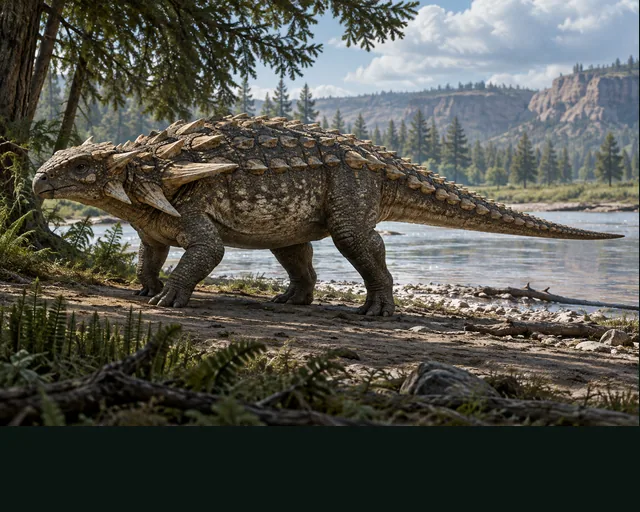
The illustration follows Connor Ashbridge’s complete Animantarx restoration: a low armoured head, broad four-legged body, shoulder spines, back scutes and tapering clubless tail. Those reconstructed details follow the reviewed artwork rather than being newly imagined from fossil fragments. Skin, colour and scenery remain artistic choices.
Compare Sauropelta and Ankylosaurus, or browse A–Z under A.
Quick answers
- Where was Animantarx found?
- In Utah, in the Mussentuchit Member of the Cedar Mountain Formation.
- How did equipment help find it?
- A sensitive radiological survey detected a signal associated with buried fossil material before obvious exposed bones were found.
- Was the complete skeleton recovered?
- No. The museum describes parts of the skull, jaw, spine and limbs, and explains that missing mount parts were modelled.
- Did it have a tail club?
- It is interpreted as a nodosaurid, the armoured branch without the large terminal club familiar in many ankylosaurids.