Jurassic Dinos editorial · Updated · Source-based review
Aniksosaurus was a small theropod dinosaur from Patagonia, Argentina. Its fossils make it an interesting test case for dinosaur behaviour because remains from five individuals were found together. That association raises a question rather than supplying a ready-made movie scene: did these animals spend time in a group?
A Patagonian theropod
Rubén Martínez and Fernando Novas formally described Aniksosaurus darwini in 2006. The remains come from the Bajo Barreal Formation of Chubut, in the early part of the Late Cretaceous. It is generally discussed among coelurosaurs, a broad theropod radiation that also includes birds and many familiar feathered dinosaurs.
The known material includes body and limb bones rather than a complete, articulated animal with every external feature preserved. A broad meat-eating interpretation follows its theropod comparisons, but the remains do not preserve a daily menu or show it attacking a particular prey species.
Testing the group-living idea
A 2013 study by Lucio Ibiricu and colleagues examined the five-individual assemblage using anatomy, burial evidence and bone histology. Histology means examining tissues at a microscopic scale. Growth patterns inside bones can provide information that a large skeleton’s overall appearance may hide.
The researchers interpreted the sampled animals as juvenile to subadult. That is an important caution when estimating adult dimensions from these specimens. A small individual is not automatically a fully grown example of a tiny species.
The authors proposed that Aniksosaurus showed some degree of gregarious behaviour during part of its life. Gregarious means spending time with others of the same species. It does not automatically mean cooperative hunting, permanent family groups or a hierarchy led by the largest animal.
Why burial history matters
Bones can be weathered, moved by water and buried in more than one episode. Researchers therefore ask how an assemblage formed before using it to infer behaviour. Animals gathering briefly near water could leave a different biological story from a lifelong social group, even if the eventual fossils look similar.
These alternatives make the investigation stronger. Scientists test competing explanations rather than choosing the most exciting one first.
Looking at the animal
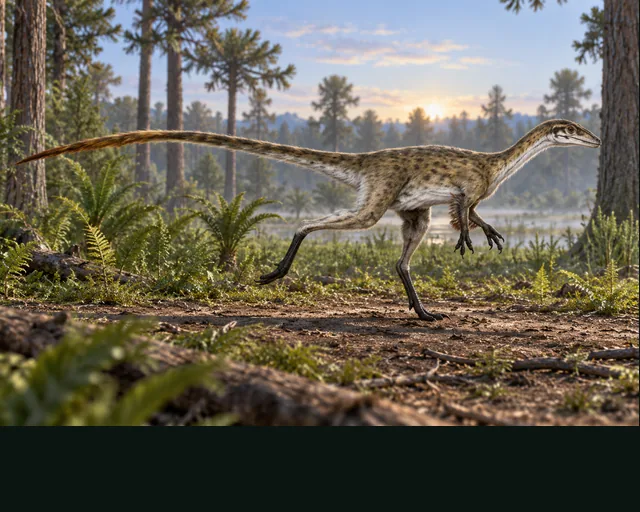
Our illustration follows Atlantis536’s complete named restoration, with a small elongated head, slender neck, short forelimbs, long hind limbs and tapering tail. Covering, colour and whole-body proportions remain artistic interpretations, not a preserved portrait or a measured adult body.
Compare Coelurus and Velociraptor, or explore more names in A–Z under A.
Quick answers
- Where was Aniksosaurus found?
- In the Bajo Barreal Formation of Chubut, Patagonia, Argentina.
- How many individuals were studied in the bonebed?
- The 2013 study examined material representing five individuals.
- Were they all fully grown?
- Bone histology in the later study indicated juvenile to subadult individuals.
- Does the bonebed prove pack hunting?
- No. The authors proposed some group behaviour, which is different from demonstrating coordinated hunting.