Jurassic Dinos editorial · Updated · Source-based review
Anhuilong was a long-necked, plant-eating sauropod from eastern China. Its name may suggest a complete giant towering above a Jurassic landscape, yet the specimen used to define it consists of only three forelimb bones. The important discovery lies in what those bones reveal through careful comparison.
Three bones from Anhui
Xin-Xin Ren, Jian-Dong Huang and Hai-Lu You described Anhuilong diboensis from the Hongqin Formation of Anhui Province. The study assigned the material to the Middle Jurassic. Its defining specimen contains a complete left humerus, ulna and radius.
The humerus is the upper arm bone. The ulna and radius run between the elbow region and the wrist. Naming these parts helps you understand both the strength and the limits of the evidence: researchers had an informative arm, not a preserved head, an entire neck or every bone in the tail.
The paper was published online in 2018 and appeared in a journal volume dated 2020. Bibliographic records may therefore display different years. Keeping track of the article and its publication history is more reliable than assuming that a later date must describe a second fossil discovery.
How can an arm identify a dinosaur?
The authors compared proportions as well as shape. They examined the relative lengths of the forelimb bones, the outline of the upper arm and details of projections near the joints. The ulna’s cross-section also contributed to the anatomical comparison.
A diagnosis works through a distinctive combination of characters. It is not simply a claim that the bones look large. Complete individual bones can preserve useful identifying details even when most of their owner’s skeleton is missing.
The study placed Anhuilong among mamenchisaurids and compared it closely with Huangshanlong, another sauropod from eastern China. That result expands the regional picture of sauropod diversity. It does not establish that every mamenchisaurid had identical limb proportions or exactly the same neck length.
The neck in the illustration
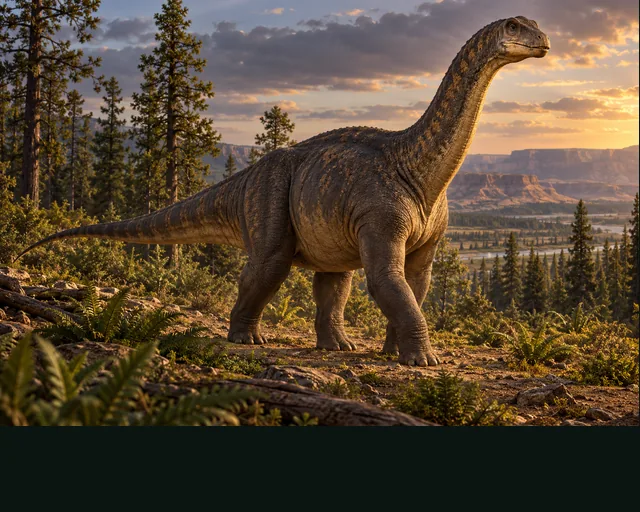
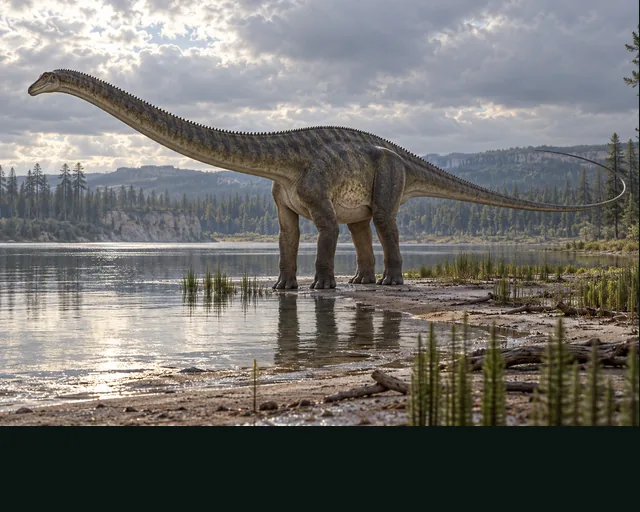
Our picture follows Levi B. Martinez-Reza’s complete named restoration, including its small head, very long raised neck, robust supporting legs and slender tapering tail. The existing artwork provides the full-body visual reference. We do not infer an unpreserved neck directly from the three arm bones.
The source’s whole-animal proportions, skin, colour and posture remain interpretations. A long-necked illustration should never be converted into a precise measurement of the missing neck.
Continue comparing
Explore Camarasaurus and Diplodocus for other sauropod examples, or browse more names through A–Z under A.
Quick answers
- Where was Anhuilong found?
- In the Hongqin Formation of Anhui Province, eastern China.
- Was a whole skeleton discovered?
- The defining specimen consists of three complete left forelimb bones, not a complete animal.
- What group did it belong to?
- The original analysis placed it among mamenchisaurid sauropods.
- Why are 2018 and 2020 both mentioned?
- The article appeared online in 2018 and in a journal volume dated 2020; these dates should not be silently conflated.