Jurassic Dinos editorial · Updated · Source-based review
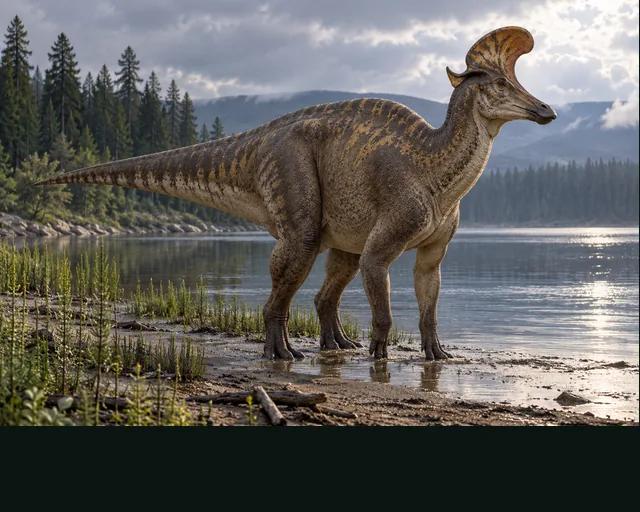
Angulomastacator was a duck-billed dinosaur from the Big Bend region of Texas. Its surviving upper jaw is much less complete than the animal shown in a restoration, but it preserves a distinctive anatomical clue. This is a dinosaur for which knowing the limits of the fossil is as valuable as recognising the name.
One important jaw bone
Jonathan Wagner and Thomas Lehman named Angulomastacator daviesi in 2009. The defining specimen, TMM 43681-1, is an incomplete left maxilla. A maxilla is a major tooth-bearing bone in the upper jaw, rather than the whole skull or a complete mouth.
The fossil came from the upper shale member of the Aguja Formation in Big Bend, within the Campanian part of the Late Cretaceous. “Member” is a subdivision within a geological formation. These place names let scientists connect the specimen with a particular rock sequence instead of simply saying that it came from Texas.
Why the jaw attracted attention
The front part of the maxilla turns downward. Researchers use the shape of such bones, their tooth-bearing margins and their connections with neighbouring bones to compare hadrosaurs. The result is more informative than matching a colourful picture to a familiar duck-billed silhouette.
A later study of the Mexican lambeosaurine Magnapaulia compared a downturned maxillary process with Angulomastacator and other members of the group. Sharing a character does not automatically make two animals the same genus. A diagnosis depends on a combination of features, and similar traits can arise in separate branches.
What kind of dinosaur was it?
The original description interpreted Angulomastacator as a lambeosaurine hadrosaur. These dinosaurs belong to the plant-eating duck-billed radiation. Its jaw supports anatomical comparisons, but it does not preserve a complete head crest, body, skin pattern or everyday feeding scene.
This distinction is easy to miss when an illustration looks convincing. A scientific classification can be supported even when the exact external appearance remains uncertain. The evidence for belonging to a group and the evidence for a particular crest outline are different questions.
The complete picture
Our artwork follows Connor Ashbridge’s reviewed whole-animal restoration, retaining its beaked head, raised crest, deep four-legged body and long tapering tail. Those missing external parts follow an existing named restoration; they are not newly guessed from the isolated jaw. Crest shape, proportions, colours and scenery remain interpretive.
Compare Lambeosaurus and Olorotitan, or explore the A–Z directory under A.
Quick answers
- What fossil defines this dinosaur?
- An incomplete left maxilla, the main tooth-bearing bone of the upper jaw, numbered TMM 43681-1.
- Where did it come from?
- The upper shale member of the Aguja Formation in Big Bend, Texas.
- Was its full crest preserved?
- No. The head crest in a whole-animal restoration is an interpretation, not a preserved outline.
- Do similar jaw features make other dinosaurs the same genus?
- No. Researchers compare a combination of characters and must distinguish shared features from diagnostic ones.