Jurassic Dinos editorial · Updated · Source-based review
Anchiceratops was a plant-eating horned dinosaur from Late Cretaceous Canada. Two long brow horns, a shorter nose horn and an ornamented frill made its head distinctive. Its fossils also offer a useful lesson: two skulls can look different without proving that they belonged to different species or different sexes.
A decorated head
The best-studied material comes from Alberta’s Horseshoe Canyon Formation. Anchiceratops belonged to the chasmosaurines, one of the main branches of large horned dinosaurs. Its frill carried prominent pointed ornaments. The Philip J. Currie Dinosaur Museum’s guide highlights a pair of hornlets near the midline that point forward.
These features help distinguish it from a generic three-horned dinosaur. Counting facial horns alone is not a reliable identification method. Their position, the shape of the frill and smaller anatomical details matter together. A beaked mouth and the feeding equipment of ceratopsids support a plant-eating interpretation, without supplying a complete list of favourite plants.
Why skull differences need investigation
A 2011 study by Jordan Mallon and colleagues examined variation in Anchiceratops. Its abstract noted at least ten partial skulls, although only two had previously received formal descriptions. The better-known examples differed in such features as brow-horn and frill proportions.
Earlier explanations had invoked different species or male and female forms. Both ideas require evidence that the variation actually separates into meaningful groups. Simply choosing the biggest horned skull as a male would assume the answer before testing it. Growth, individual differences and distortion during burial are also issues researchers need to consider.
For a young fossil detective, this is a useful habit: first describe the difference, then ask what could explain it. A dramatic-looking feature is a question to investigate rather than an automatic label.
Reading a restoration carefully
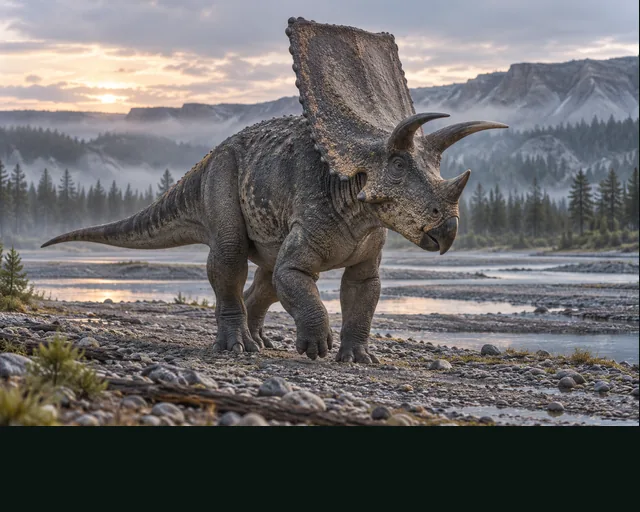
Our image follows the Natural History Museum’s complete Anchiceratops artwork. It preserves the long forward brow horns, pointed frill edge, stocky four-legged body and tapering tail shown in that reference. The composition and scenery are newly designed.
The image is an artistic restoration, not a photograph or a claim that every body part was found attached to one diagnostic skull. Exact skin colour, soft tissues and behaviour remain uncertain. Neither the illustration nor a museum mount can by itself establish a precise body mass, sex or lifestyle.
Keep comparing
Read about Chasmosaurus and Triceratops to see how other ceratopsid heads differ. Use the A–Z directory to continue exploring names without treating every three-horned silhouette as the same animal.
Quick answers
- Where did Anchiceratops live?
- Its best-studied skulls come from the Horseshoe Canyon Formation of Alberta, Canada.
- How many facial horns did it have?
- Two long brow horns and a shorter nasal horn.
- Do different horns prove male and female forms?
- No. Variation needs testing before specimens can be divided into sex categories.
- Can a museum mount settle every body proportion?
- No. Restored or associated parts must be distinguished from securely identified original material.