Jurassic Dinos editorial · Updated · Source-based review
Amygdalodon was a long-necked, plant-eating dinosaur from Patagonia in Argentina. Its name means “almond tooth”, a reminder that a small fossil feature can become the best-known label for an enormous animal. The surviving material is fragmentary, so understanding this dinosaur starts with sorting evidence rather than measuring a complete skeleton.
An early chapter in Patagonia
Ángel Cabrera named Amygdalodon patagonicus in 1947. The fossils came from the Cerro Carnerero Formation in Chubut. Oliver Rauhut’s 2003 revision discussed a late Early Jurassic to early Middle Jurassic age range for the material. This is more cautious than assigning every bone an exact birthday.
Amygdalodon belongs among sauropods, the dinosaur group with long necks, large bodies and four weight-bearing limbs. Its teeth and sauropod relationships support a plant-eating interpretation. They do not reveal a complete menu, the height of every meal, or the number of hours it spent feeding.
Why the collection needed sorting
The Natural History Museum’s short directory entry describes a partial skeleton. The detailed 2003 revision adds an essential qualification: the original material includes at least two sauropod individuals and a piece from a different, unidentified vertebrate. These are not interchangeable descriptions of one intact animal.
Rauhut selected a back vertebra as the lectotype. A lectotype is a specimen chosen from an original collection to anchor a scientific name when that name was not securely tied to one individual piece. This does not magically complete the animal. It makes future comparisons more precise.
The revision interpreted the sauropod material as belonging to very early members of Eusauropoda, a major sauropod branch. Such evolutionary placements are scientific proposals tested with anatomical comparisons. A diagram of relationships may change as researchers add better specimens or reconsider the characters they compare.
Looking at the whole animal
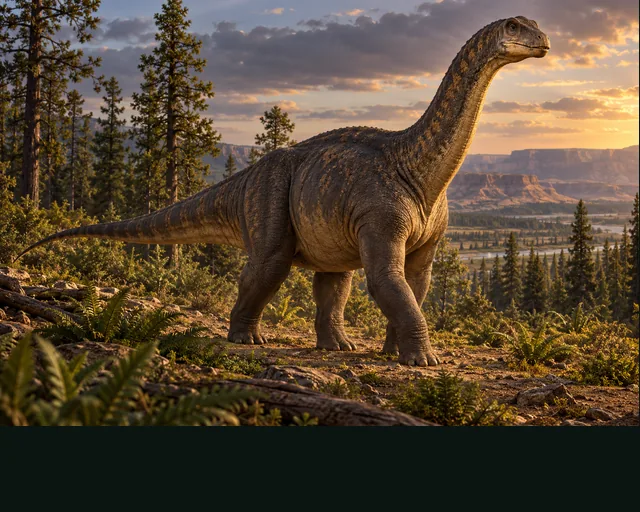
The illustration follows the Natural History Museum’s complete restoration, with a small head, a nearly horizontal neck, a deep trunk and a long tapering tail. Its proportions come from that named visual reference. The artwork is not a photograph of a complete Amygdalodon skeleton brought to life.
Body outline, colour and soft tissues remain reconstructed. Because the fossil collection is incomplete and mixed, a confident-looking image should not be used to claim an exact body length or mass.
More long-necked dinosaurs
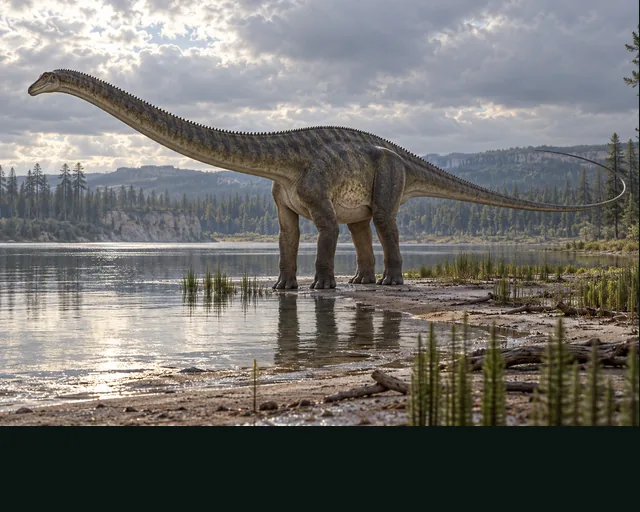
Visit Camarasaurus and Diplodocus to compare other sauropod stories. They are separate animals, not substitute evidence for missing Amygdalodon anatomy. Find more names in the A–Z directory.
Quick answers
- What does Amygdalodon mean?
- The name means almond tooth, referring to the outline of its teeth.
- Where did it live?
- Its fossils come from Jurassic rocks in Chubut, Argentina.
- Was the original collection one skeleton?
- The 2003 revision identified material from at least two sauropod individuals and another vertebrate.
- Do we know its exact size?
- Published reconstructions are estimates; the fragmentary material does not provide a complete measured body.