Jurassic Dinos editorial · Updated · Source-based review
Amurosaurus was a plant-eating duck-billed dinosaur from Far Eastern Russia. It belonged to the lambeosaurines, the hadrosaur branch best known for elaborate head crests. Its story is especially useful for learning how scientists connect scattered fossils without pretending that they found one perfectly complete animal.
A dinosaur beside the Amur
The species Amurosaurus riabinini was named by Yuri Bolotsky and Sergei Kurzanov in 1991. A larger study published in 2004 examined many separate bones from Blagoveschensk. These came from the Udurchukan Formation, a rock unit assigned to the closing part of the Cretaceous. A formation is a named package of rocks; it is not a single moment in time.
The researchers identified distinctive features in both skull and body bones. Their comparisons supported Amurosaurus as a valid dinosaur rather than an unnamed mixture of familiar hadrosaurs. However, many bones lying together do not automatically make a complete, connected skeleton. Keeping track of which pieces belong together is part of the investigation.
What can a braincase tell us?
A later study investigated the space enclosed by the skull around the brain. Researchers made endocasts: models of the internal cavity. Imagine modelling the inside of an empty container. You can learn about its shape without recovering the original contents.
The study described a broad olfactory tract, associated with the sense of smell, and rounded cerebral hemispheres. Comparisons suggested interesting questions about hadrosaur senses and behaviour. They did not recover a living brain, measure this dinosaur’s intelligence directly, or demonstrate a particular social routine. Fossil anatomy provides clues with limits.
Reading the restoration
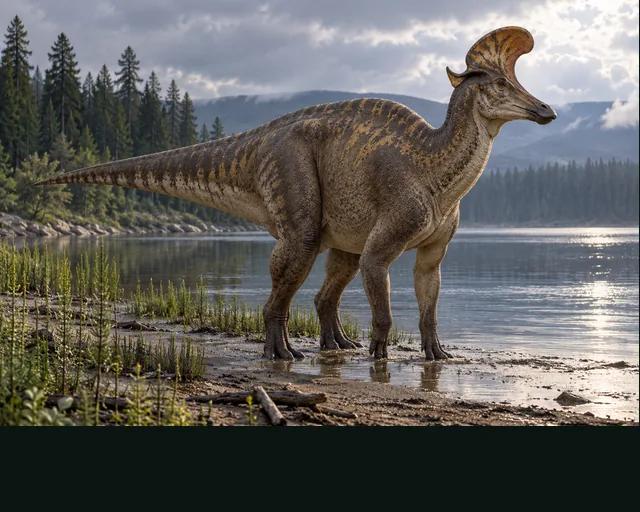
Our illustration follows a complete Amurosaurus restoration by Connor Ashbridge. It shows a deep body, four supporting limbs, a long tail and a modest forward-directed crest. The source supplies the complete visual reference; this image is not assembled by guessing missing anatomy from isolated bones.
The crest silhouette, skin colour and surrounding landscape remain artistic choices. An attractive picture can communicate an animal’s general appearance while still leaving scientific questions open. In particular, a restored crest should not be mistaken for an entirely preserved crest specimen.
Continue exploring
Compare this animal with Lambeosaurus to explore another lambeosaurine, or read about Olorotitan, found at Kundur rather than Blagoveschensk. The A–Z dinosaur directory helps you keep these related names separate.
Quick answers
- Where was Amurosaurus found?
- At Blagoveschensk in the Amur region of Far Eastern Russia.
- Was its brain preserved?
- The research examined casts of spaces inside fossil braincases, not surviving brain tissue.
- Is its exact crest shape certain?
- No. The crest outline in a restoration is an interpretation.
- Was it the same dinosaur as Olorotitan?
- No. They are separately named lambeosaurines from different localities in the Amur region.