Jurassic Dinos editorial · Updated · Source-based review
Which Amphicoelias does this page describe?
This account concerns Amphicoelias altus, a sauropod named by Edward Cope in 1877 from the Late Jurassic Morrison Formation of the western United States. Its history is often mixed with spectacular claims about other fossils once placed under similar names. Keeping the specimens separate is essential.
The defining material included back vertebrae, a partial pubis and a femur. It does not preserve a complete head-to-tail animal. A 2021 anatomical reassessment restricted Amphicoelias altus to its holotype individual rather than combining it with every historically referred sauropod bone.
Was it just another name for Diplodocus?
Some researchers had questioned whether Amphicoelias represented a growth stage or synonym of Diplodocus. The 2021 study re-examined the bones and recognised a distinctive combination of features, including three proposed unique characteristics. Its analyses supported keeping Amphicoelias and Diplodocus as separate genera.
The authors also found uncertainty in exactly where Amphicoelias fits within Diplodocoidea. Supporting a distinct genus and resolving every branch of its family tree are different tasks. The first conclusion can be stronger than the second.
Why do giant-size stories cause confusion?
A different historical name, Amphicoelias fragillimus, was based on a very large vertebral fragment that is now lost. In 2018, Carpenter proposed the new genus Maraapunisaurus for that material. The argument relies on Cope’s old description and illustration because the original fossil is unavailable for direct study.
Those disputed reconstructions should not be used as dimensions for Amphicoelias altus. Sharing a historical genus label does not make two specimens interchangeable. Nor does the loss of a fossil allow us to recover an exact living body length simply by choosing a large-looking illustration.
What does the fossil say about its life?
Its sauropod relationships support a plant-eating interpretation, but the reviewed material does not establish a detailed diet, a particular feeding height or an exact body mass. We leave those numerical comparison fields unset rather than borrowing estimates from the lost fragillimus specimen.
What does the image show?
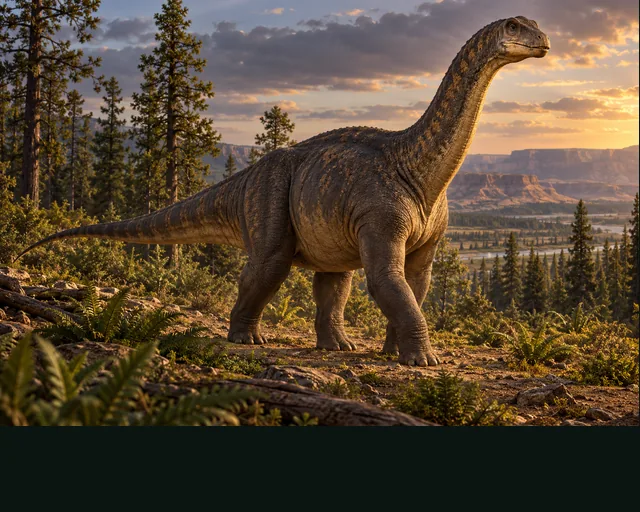
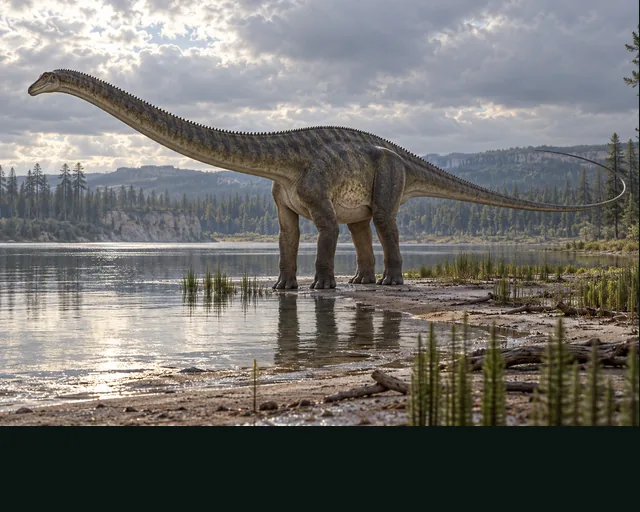
Our artwork follows Dmitry Bogdanov’s complete restoration explicitly labelled Amphicoelias altus. Its long neck, deep torso, four legs and slender tail follow that named image. The full outline, skin and colours remain artistic interpretations. The picture is neither a measurement nor a reconstruction of Maraapunisaurus under an older name.
Compare Diplodocus and Camarasaurus, or explore the A–Z directory under A.
Quick answers
- Which species is discussed here?
- Amphicoelias altus, anchored to its defining Morrison Formation individual.
- Was Diplodocus renamed?
- The 2021 reassessment supported retaining Amphicoelias and Diplodocus as separate genera.
- Is the lost fragillimus fossil the same defining material?
- No. Carpenter proposed Maraapunisaurus for that different historical specimen.
- Can huge fragillimus estimates be used as altus dimensions?
- No. Different specimens and uncertain reconstructions must not be mixed into this animal's measurements.