Jurassic Dinos editorial · Updated · Source-based review
Did the name Amargatitanis make it a titanosaur?
Amargatitanis was a sauropod from Early Cretaceous Patagonia, Argentina. It was originally interpreted as a titanosaur when described in 2007, but a detailed 2016 reassessment recovered it among dicraeosaurids instead. The history shows why a scientific name should not be treated as an unchangeable family label.
The fossils come from the La Amarga Formation. This unit also preserves the better-known Amargasaurus, but the two names do not refer to the same animal. Gallina’s revision supported Amargatitanis macni as a distinct taxon with a revised diagnosis.
Why did researchers check the field notes?
The original specimen grouping included bones whose association had been questioned. The reassessment examined the fossils and original collecting information to work out which elements could reasonably belong together. It proposed a modified holotype after recognising that the original grouping mixed material.
This is not simply a matter of choosing the most impressive pieces for a display. If unrelated bones are combined, the resulting animal can appear to have a combination of features that never belonged to one individual. Field numbers, rock layers and collecting notes help researchers test those associations.
What evidence supports the revised placement?
The 2016 study re-examined the available anatomy, described previously unpublished material and added the revised animal to an updated evolutionary analysis. Its result placed Amargatitanis within Dicraeosauridae, on the diplodocoid branch of the sauropod family tree.
This conclusion changes the interpretation of the particular material. It should not be expanded into a claim that no other sauropod group could ever be discovered in those rocks. New finds can add information about a formation’s fauna without changing the identity of an already studied specimen.
Did it have exactly the same neck as Amargasaurus?
No complete Amargatitanis head-to-tail skeleton establishes that. A family relationship is not enough to transfer another genus’s distinctive neck structures or exact proportions. Its full living appearance remains substantially reconstructed.
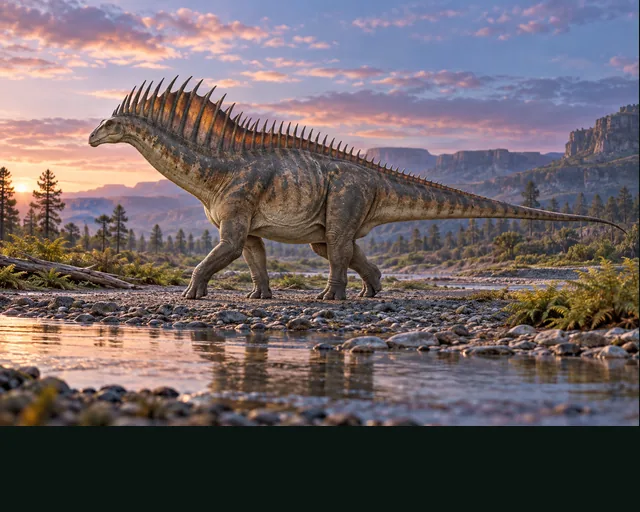
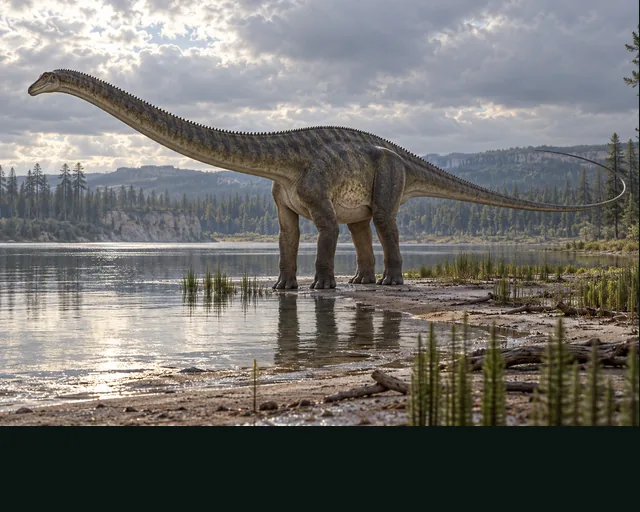
Our image follows Levi Martinez-Reza’s complete artwork specifically labelled Amargatitanis. The artist discloses comparative reconstruction using Amargasaurus information. We use that finished named reference, not a separate Amargasaurus image or skeletal diagram, and do not describe every restored feature as diagnostic evidence.
What can we say about food and size?
Its sauropod relationships support a plant-eating interpretation. The sources reviewed here do not establish an exact adult length, mass, daily plant menu or feeding posture. Those questions are kept separate from the stronger evidence about specimen association and classification.
Compare Amargasaurus and Diplodocus, or explore the A–Z directory under A.
Quick answers
- Does its name prove it was a titanosaur?
- No. The original interpretation changed; the 2016 reassessment placed it among dicraeosaurids.
- Why were field notes important?
- They helped test which bones were associated and which had been incorrectly combined.
- Is it the same animal as Amargasaurus?
- No. The revision supported Amargatitanis as a distinct taxon.
- Can its entire neck be copied from a relative?
- No. Missing features in the fossil are not established by a family relationship or by an artist's comparative reconstruction.