
Jurassic Dinos editorial · Updated · Source-based review
Why did a second Alnashetri skeleton matter so much?
Alnashetri was a tiny alvarezsauroid dinosaur from Cretaceous Argentina. The original specimen was very incomplete, but a much more complete individual described in 2026 transformed what researchers could test about the animal and its relatives. The discovery came from the La Buitrera fossil region of Río Negro, Patagonia.
The newer skeleton includes information about the skull, teeth, limbs and body that was unavailable from the earlier hind-limb material. It is exceptionally informative, although parts of the skull roof, tail and right side remain missing. “Nearly complete” does not mean that every bone is present.
Were all small alvarezsaurs specialised termite eaters?
The new study challenged a simple story in which the group became progressively smaller while specialising in eating social insects. Alnashetri was already tiny, but its hand and teeth did not show the same extreme specialisations seen in some later alvarezsaurids.
Its fingers were not reduced to the strongly simplified pattern familiar from those later animals, and its teeth were not as miniaturised. The researchers recovered it on an early branch outside Alvarezsauridae within the broader Alvarezsauroidea. Those names describe nested groups, so an alvarezsauroid need not be an alvarezsaurid.
How did the research change the size-evolution story?
The 2026 analysis did not support a single overall trend of evolutionary miniaturisation. Instead, its models supported repeated changes within a relatively limited range of body sizes. A small early-branching animal can change the interpretation of a family tree, especially when earlier samples were incomplete.
That conclusion applies to the dataset and analyses in the study. It does not mean that no alvarezsaur lineage ever became smaller, or that a single fossil answers every question about their evolution.
How small was this individual?
CONICET’s account describes an animal around seventy centimetres long and approximately one kilogram in mass. These are reconstructed estimates. Bone-tissue study indicated an individual at least four years old whose growth had slowed, suggesting it was close to adult size. A tiny dinosaur is not automatically a hatchling.
Its likely food included small animal prey, but we do not present a particular captured insect or vertebrate as a preserved meal. The anatomical evidence weakens a simple assumption that every tiny member of the group was a specialised termite eater.
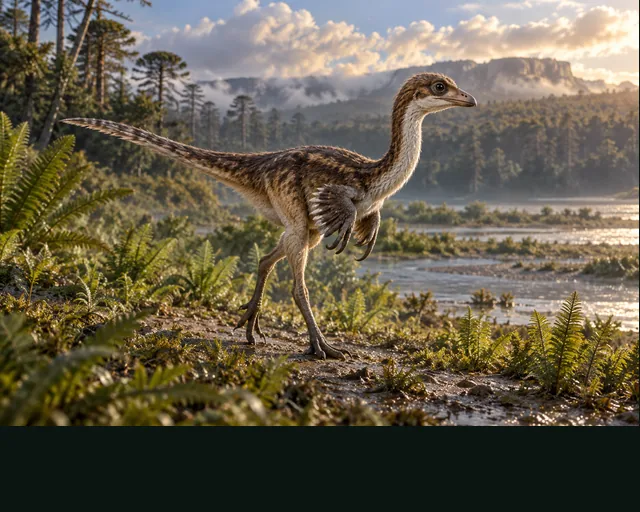
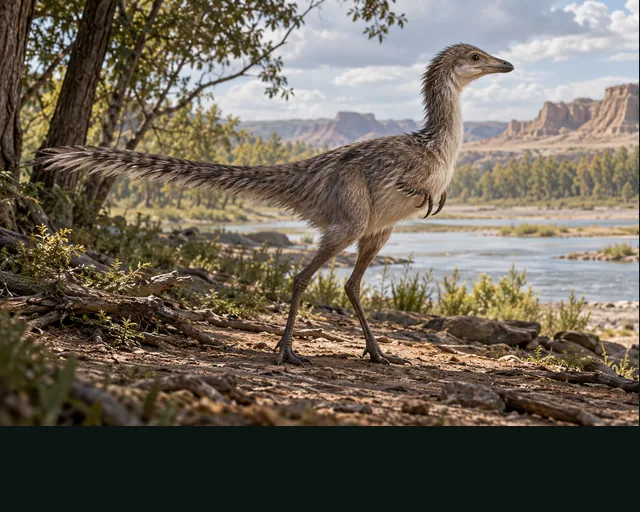
What does our illustration follow?
The image uses Gabriel Díaz Yantén’s complete, explicitly named restoration associated with the 2026 research and credited through CONICET. Feathering, colour and soft tissues remain artistic interpretations. A second complete scene by the same credited artist shows the feet that were obscured in the detail view. Both references are recorded; no missing toe anatomy is invented from a skeleton.
Compare Alvarezsaurus and Mononykus, or return to the A–Z directory under A.
Quick answers
- Why did the 2026 specimen matter?
- It preserved far more anatomy than the earlier fragmentary individual and improved tests of relationships and body-size evolution.
- Was it a specialised termite eater?
- The new hand and teeth did not show the same extreme specialisations as some later alvarezsaurids.
- Was its small size simply because it was a baby?
- The institutional account reports slowed growth in an individual at least four years old, interpreted as close to adult size.
- Is every bone present?
- No. Parts of the skull roof, tail and right side remain missing.
.jpg)