Jurassic Dinos editorial · Updated · Source-based review
Why was a land dinosaur buried in marine rocks?
Aletopelta was an armoured dinosaur from the Late Cretaceous of what is now southern California. Its partial skeleton was found near Carlsbad in the Point Loma Formation, a rock unit deposited in a marine setting. That burial environment does not establish that the living animal was an ocean-dwelling dinosaur.
The earlier scientific description discussed the skeleton before it received the name Aletopelta coombsi in 2001. The material includes hind limbs, hip bones, parts of the forelimbs and substantial armour. The skull and complete tail are missing.
What does the armour preserve?
The San Diego Natural History Museum describes much of the armour over the pelvic region as retaining its arrangement around the hips. That is useful evidence because isolated armour plates can be difficult to position on a living animal. The specimen also includes shoulder scutes, spikes, other armour and teeth.
Some armour relationships are therefore better constrained than others. The whole body should not be treated as a perfectly known suit of plates. The museum specifically notes uncertainty about how the projecting spikes were arranged.
Was it a nodosaurid or an ankylosaurid?
The specimen’s research history includes both interpretations. Coombs and Deméré’s 1996 description treated it as an indeterminate nodosaurid. Ford and Kirkland’s later work placed it among ankylosaurids when establishing the named animal. Missing skull and tail evidence complicates comparisons between these armoured-dinosaur branches.
For readers, the important lesson is that an earlier classification and a later name can refer to the same fossil. They are not separate discoveries that should automatically be counted as different animals.
Does marine burial reveal its normal habitat?
The 1996 study did not support an aquatic lifestyle for nodosaurids. The museum likewise explains that this animal’s normal habitat, including whether it preferred estuaries or inland areas, remains uncertain. An animal’s burial place can differ from the place where it spent most of its life.
Transport after death is one possible reason for terrestrial remains in marine deposits. Establishing the exact journey of this individual requires more than noticing marine fossils nearby. We therefore avoid illustrating it as a specialised swimmer or inventing a detailed last voyage.
Why is the illustrated tail clubless?
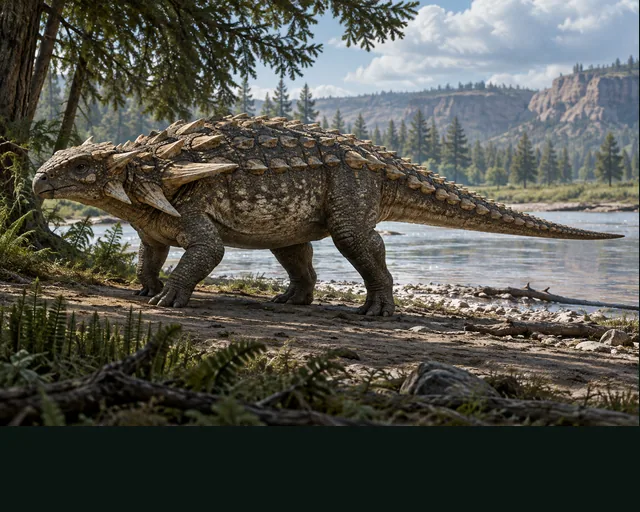
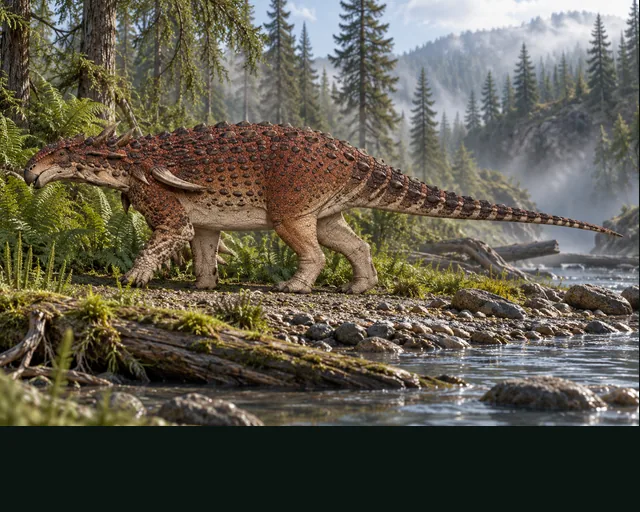
Our image follows Nobu Tamura’s complete, named Aletopelta restoration, which has a tapering tail without a large terminal club. The fossil itself does not preserve a complete tail, so this visual choice is not proof that a club was absent. Colours, head shape and parts of the armour pattern also remain artistic interpretations.
Explore Borealopelta and Sauropelta, or use the A–Z directory under A.
Quick answers
- Did Aletopelta live in the ocean?
- Marine burial does not establish an aquatic lifestyle; its normal habitat remains uncertain.
- Where was its fossil found?
- Near Carlsbad, California, in the Point Loma Formation.
- Is a tail club preserved?
- No complete tail is preserved. The clubless artwork follows a named restoration and does not prove absence.
- Was all armour placement lost?
- No. Much pelvic armour retained its arrangement, although the placement of projecting spikes remains uncertain.