Jurassic Dinos editorial · Updated · Source-based review
What is special about Albinykus?
Albinykus was a very small alvarezsaurid dinosaur from Mongolia’s eastern Gobi region. Nesbitt and colleagues named Albinykus baatar in 2011. The defining fossil preserves part of the body behind the head, including the pelvis and hind limbs, with bones still associated in an unusual crouched position.
The specimen attracted attention for both its small size and the fusion of bones around the ankle and foot. It adds an important comparison to a group whose members can have surprisingly specialised limbs.
What does a crouching fossil show?
The hind limbs were aligned and the feet tucked beneath the body. The original study compared this seated posture with positions known in birds and some other theropod dinosaurs. It was a notable example within Alvarezsauridae.
A preserved position is not a complete explanation of the animal’s final moments. The skeleton does not establish a bedtime routine, an exact cause of death or a particular storm. Those possibilities would need to be tested using the surrounding sediment and other evidence.
Were its ankle bones fused together?
The study described extensive joining of ankle bones with the lower leg and of other ankle bones with the upper part of the foot. Fusion means that bones which can begin as separate elements become connected during development. It does not mean the animal lacked all movement at the ankle.
The authors also examined bone tissue and interpreted the individual as a subadult. That is a useful warning against treating every small fossil as either a hatchling or a fully grown adult solely because of its size. Anatomy and microscopic growth evidence provide additional tests.
How small was it?
The original paper estimated a body mass no greater than about one kilogram. This is the study’s reconstruction-based estimate, not the weight of a complete preserved animal. We keep the attribution and do not convert it into a precisely corroborated comparison measurement.
The fossil does not preserve a full head or a demonstrated food menu. In particular, we do not transfer every feeding hypothesis proposed for other alvarezsaurs directly to Albinykus.
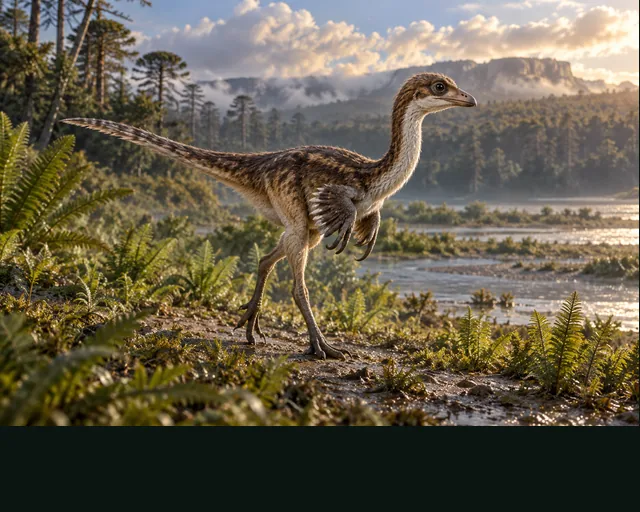
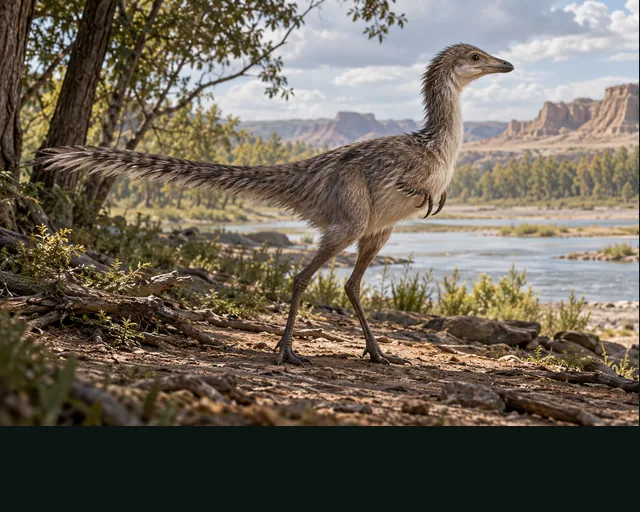
Why does the illustration have a complete head and tail?
The artwork follows Levi Martinez-Reza’s existing complete restoration explicitly labelled Albinykus. The artist discloses comparative reconstruction in the missing parts. Our production uses that finished, named body reference and does not derive a new outline from a composite skeleton or a relative’s separate image. Covering, colours and much of the complete appearance remain interpretive.
Compare Alvarezsaurus and Mononykus, or browse the A–Z directory under A.
Quick answers
- Where was Albinykus found?
- Its defining fossil comes from Mongolia's eastern Gobi region.
- What is unusual about its preserved posture?
- The hind limbs were aligned with the feet tucked under the body.
- Does fusion mean its ankle could not move?
- No. Fusion joins some bones; it does not establish that all movement at a joint was impossible.
- Do we know exactly how it died?
- No. A crouched position alone does not establish a particular cause of death.