Jurassic Dinos editorial · Updated · Source-based review
Why did a small dinosaur make a big discovery?
Ahvaytum is a small early dinosaur described in 2025 from Wyoming. Its importance lies less in spectacular size than in its age and location. The discovery helped test when dinosaurs were living in the northern part of the ancient supercontinent Pangaea.
The original study placed it among probable early sauropod relatives. That does not make it a miniature version of a later giant sauropod. Early members of the broader dinosaur family tree could differ greatly from the enormous animals that appeared much later.
What fossils were actually found?
The defining specimen is an ankle bone from the Popo Agie Formation. The original taxonomic treatment also discussed a nearby partial thigh bone. These are small parts of an animal, but their shapes preserve features that can be compared with other early dinosaurs.
The research does not provide a complete skull-to-tail skeleton. In particular, the missing skull limits direct evidence about its food. A possible family relationship can suggest questions about diet, but it cannot supply a preserved meal or an exact menu.
How did researchers work out its age?
The team studied the geological sequence and dated rocks in the formation using radioisotopic methods. These methods use the predictable change of certain atoms as a geological clock. The 2025 study placed the dinosaur at roughly 230 million years old, close in age to some early southern-hemisphere dinosaur records.
This is a claim about the fossils and dating available to that study. It is not a declaration that the first dinosaur evolved in Wyoming. The oldest fossil found in one region sets a minimum for known presence there; earlier animals may remain undiscovered elsewhere.
Who chose the name?
Eastern Shoshone elders and students helped create the scientific name in their own language. The university describes the full name as broadly meaning “long ago dinosaur.” Naming was part of a wider collaboration involving the researchers and the community whose ancestral lands include the fossil locality.
That history makes the name more than a pronunciation challenge. It records the people who contributed knowledge and choices to the research. Scientific discoveries depend on communities, collections and long-term relationships as well as individual fossil finds.
Does the picture show preserved feathers?
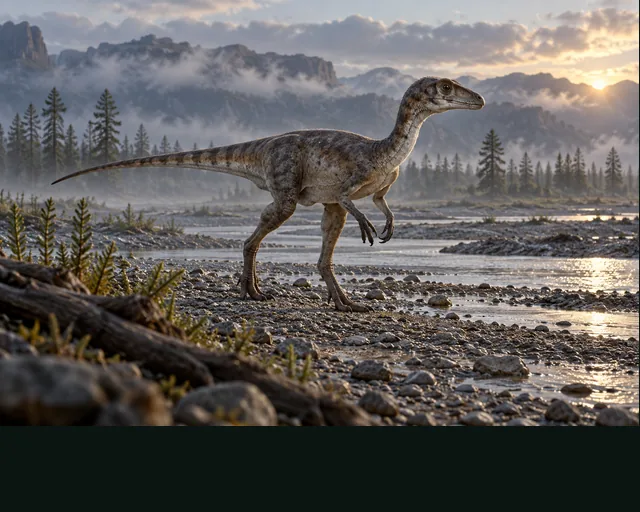
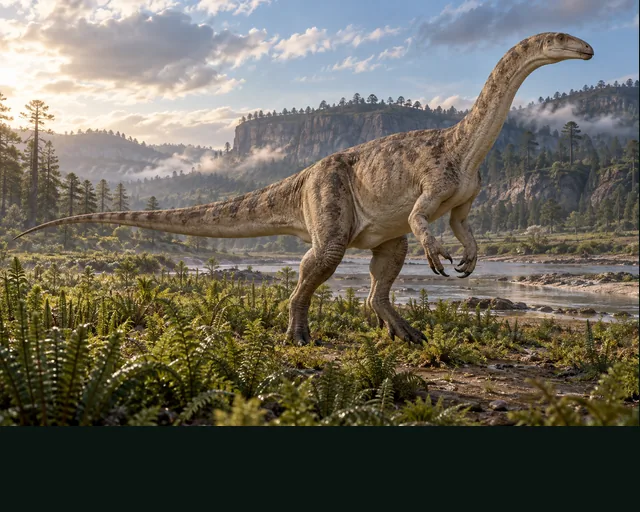
No. Our image follows Ddinodan’s complete restoration specifically labelled Ahvaytum. Its feather covering, head shape and complete body proportions are interpretive features of that reference, not structures demonstrated by the known ankle and thigh material. The illustration presents one possible living appearance while the article keeps the fossil evidence separate.
Meet other early dinosaurs in Eoraptor and Plateosaurus, or browse the A–Z directory under A.
Quick answers
- Was Ahvaytum a giant sauropod?
- No. It was a small early dinosaur interpreted as a probable early sauropod relative.
- How old are its fossils?
- The 2025 study's geological age model placed them at roughly 230 million years old.
- Who helped choose the name?
- Eastern Shoshone elders and students helped name it through collaboration with the research team.
- Are its feathers preserved?
- No. The feathers and complete body outline follow the named artistic reference, not the fragmentary known hindlimbs.