Jurassic Dinos editorial · Updated · Source-based review
A horned dinosaur from West Texas
Agujaceratops was a plant-eating horned dinosaur from the Late Cretaceous of West Texas. Its fossils occur in the Aguja Formation in the Big Bend region. The genus name connects those rocks with the horned face that makes this animal’s group so recognisable.
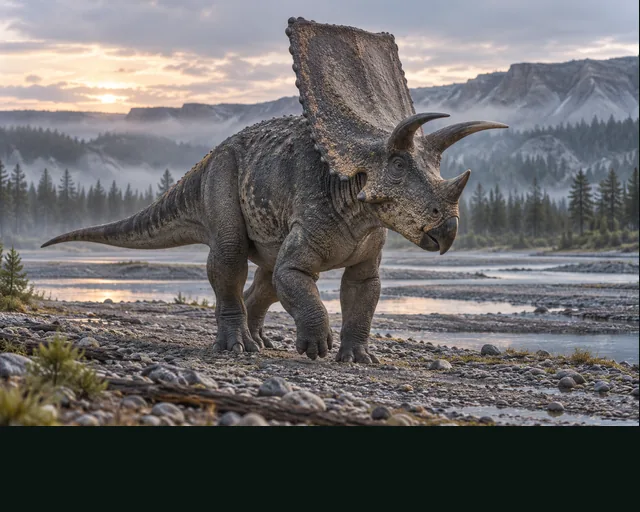
Our illustration follows a complete restoration of Agujaceratops mariscalensis. Its large frill, brow horns and beaked face provide a memorable silhouette, but the story behind its scientific name is equally useful.
Why do older sources call it Chasmosaurus?
Thomas Lehman originally described the species as Chasmosaurus mariscalensis in 1989. In 2006, Spencer Lucas, Robert Sullivan and Adrian Hunt argued that its differences warranted a separate genus, Agujaceratops.
Their comparison included the shapes of skull and jaw bones and the long brow-horn cores. A horn core is the bony structure underlying a horn, not necessarily the complete outer horn as it appeared in life. The reassignment concerned a combination of features rather than simply finding that one individual had impressive horns.
An older label therefore need not refer to a different fossil discovery. It may record an earlier interpretation of the same species.
What was ancient Big Bend like?
The National Park Service describes a landscape that changed through time, with marine, coastal and terrestrial deposits recording different chapters. Cretaceous Big Bend was closer to the equator than it is today, and some of its dinosaur-bearing environments were vegetated coastal lowlands.
It is important not to combine every Big Bend fossil into one scene. Fossils in different formations can be separated by millions of years. A park protects a place, but its rocks preserve many successive worlds.
Were its horns only weapons?
A dramatic horn does not come with a fossil instruction manual. Establishing how an animal used a structure can involve growth patterns, damage, mechanics and comparisons with living animals. The sources used for this account chiefly address identification and geological setting, so we do not claim a documented fighting technique.
The same caution applies to an exact body mass or a favourite plant. A herbivorous feeding role is appropriate, but a detailed menu requires evidence beyond a general group assignment.
How should you read the illustration?
The image follows the named full-body artwork drawn by Robinson Kunz and coloured by Rebecca Slater. Its pose, skin colour and soft-tissue outline are interpretive. The horns overlap in this side-oriented view; the image is not a labelled anatomy diagram or a new measurement of the fossil skull.
Compare Chasmosaurus, explore Triceratops, or browse dinosaur names beginning with A.
Quick answers
- Where did Agujaceratops live?
- Its fossils come from the Aguja Formation in the Big Bend region of West Texas.
- Why is it also called Chasmosaurus mariscalensis?
- That was the species' original 1989 combination. Researchers assigned it to Agujaceratops in 2006.
- Was it a meat eater?
- No. Agujaceratops was a plant-eating ceratopsian.
- Which species does the artwork show?
- The complete reference is specifically labelled Agujaceratops mariscalensis; colour and soft tissues remain artistic interpretations.