
Jurassic Dinos editorial · Updated · Source-based review
A dinosaur whose family-tree position changed
Afromimus tenerensis was a theropod dinosaur from Niger. Its incomplete remains became a useful test of how researchers distinguish animals that can look similar in broad outline. The original description placed it with ornithomimosaurs, the group often called ostrich mimics. A later reassessment instead supported a place among abelisauroid ceratosaurs.
These are different branches of the theropod family tree. The change is a reminder that scientific classification depends on anatomical comparisons, rather than the impression created by a reconstructed silhouette.
What was actually discovered?
Paul Sereno’s 2017 description identified material from the El Rhaz Formation. It included tail vertebrae, chevrons and parts of the right hind limb. Chevrons are bones beneath the tail vertebrae; they are different from the projections on top of the backbone.
The original paper placed the remains in the Early Cretaceous, using an Aptian–Albian age assignment. This account follows that broad placement without treating the boundaries of those stages as a precisely measured date for the individual animal.
The specimen did not supply a complete head and body. That limits the kinds of questions the fossils can answer directly.
Why did researchers reconsider its identity?
In 2019, Mauricio Cerroni and colleagues compared Afromimus with a wider range of theropods. Their anatomical comparisons and family-tree analysis supported Abelisauroidea, probably close to noasaurids, rather than the original ornithomimosaur interpretation.
A family-tree analysis compares many characteristics across many animals. If only a small part of a skeleton is available, some useful comparisons are missing. Adding different relatives or reassessing a feature can therefore change the best-supported arrangement.
The later study did not make the original bones disappear. It changed the interpretation of what their features indicated.
Was it a fast runner or a specialised hunter?
Long-legged artwork can suggest speed, but it is not a running experiment. The reviewed sources do not establish an exact top speed, a preserved meal or a particular hunting method for Afromimus. Its feeding habits are left uncertain here rather than borrowed wholesale from a proposed relative.
How was the complete illustration made?
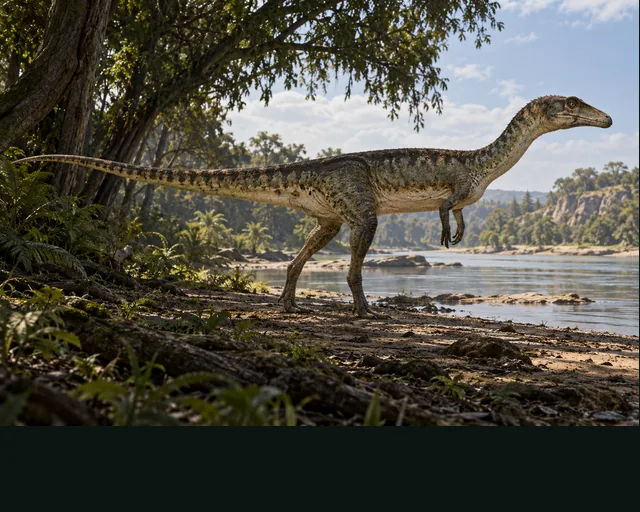
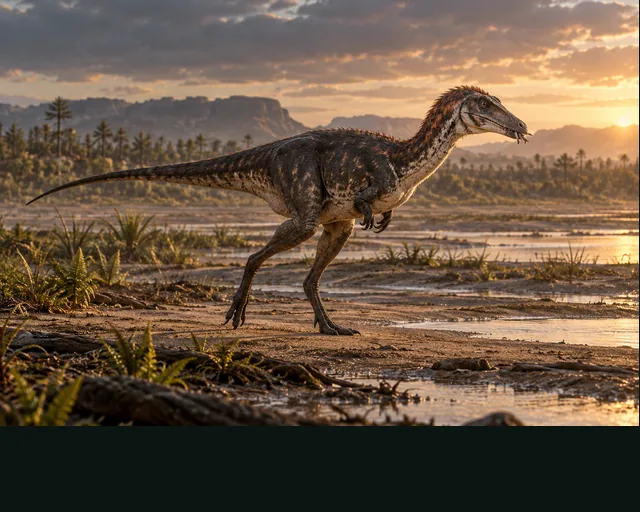
The image follows Levi Martinez-Reza’s complete restoration specifically labelled Afromimus. The artist’s source record says that comparisons with Masiakasaurus informed the missing body. That is a limitation of the reference, not evidence that the two animals had identical heads or proportions.
We used the named full-body artwork, not a skeleton or a different animal’s picture, as the visual guide. Its skin, missing anatomy and scenery remain interpretive.
Compare Masiakasaurus, Elaphrosaurus, and other dinosaur names beginning with A.
Quick answers
- Where was Afromimus found?
- In the El Rhaz Formation of Niger.
- Was it an ostrich-mimic dinosaur?
- That was the original 2017 interpretation. A 2019 reassessment instead supported an abelisauroid relationship.
- Was a complete body discovered?
- No. The description concerns tail bones and parts of a hind limb, among fragmentary material.
- Is its precise diet known?
- The sources reviewed here do not establish its own preserved meal or specialised feeding method.
.png)