Jurassic Dinos editorial · Updated · Source-based review
An ostrich-like dinosaur identified from a foot
Aepyornithomimus was an ornithomimid dinosaur from Late Cretaceous Mongolia. Ornithomimids are often called ostrich mimics because of their bird-like overall appearance, but the specimen used to name this animal is much less complete than a living outline. Its identity rests on a foot and associated ankle material.
Chinzorig and colleagues described Aepyornithomimus tugrikinensis in 2017 from Tögrögiin Shiree in the Djadokhta Formation. The Paleobiology Database records the genus within Ornithomimidae and assigns its occurrence to the Campanian, a division of the Late Cretaceous.
What makes the foot distinctive?
The original study compared the shapes and contacts of its foot bones. Features included the arrangement of ankle-bone depressions, curved contacts between particular metatarsals and an elongated fourth toe. Metatarsals are the long bones between the ankle and the toes.
The foot also has an arctometatarsalian arrangement: the central metatarsal is narrowed between neighbouring bones near the ankle. That long word describes a structure, not a measured running speed. Researchers use combinations of features to recognise relationships and differences; a single familiar-looking outline is not enough.
Why do connections between bones matter?
Try imagining a puzzle without the box picture. The shapes of adjoining edges help you place the pieces. In a fossil foot, contact surfaces similarly show how bones fit together. Comparing those surfaces with other specimens can be more informative than simply asking whether a bone looks long or short.
This does not turn the preserved foot into a complete skeleton. Questions about the skull, trunk and feather coat require different evidence.
What did Aepyornithomimus eat?
The reviewed foot material does not preserve teeth, a beak or stomach contents that establish its own diet. Its family relationships offer comparisons, but this page leaves its specific feeding habits uncertain. Likewise, it gives no exact running speed or adult body mass. A fast-looking restoration is not a stopwatch measurement.
Why is the picture feathered?
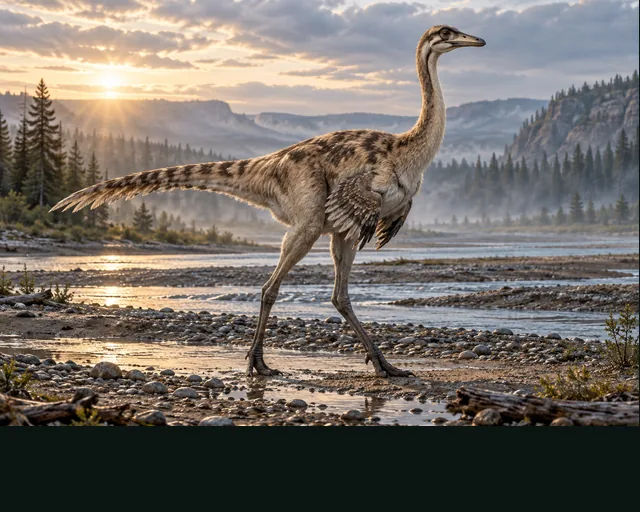
The illustration follows Masato Hattori’s complete restoration labelled Aepyornithomimus tugrikinensis. Its elongated neck, feathered forelimbs and body covering are interpretations in that named artwork. Our scene changes the pose and setting while retaining the reference’s restored silhouette. It does not use a fossil foot to invent a missing body.
The important distinction is between the animal we can picture and the structures researchers can directly compare. Both are useful when their limits are clear.
Explore Ornithomimus, Gallimimus, or dinosaur names beginning with A.
Quick answers
- Where was Aepyornithomimus found?
- At Togrogiin Shiree in Mongolia's Djadokhta Formation.
- Was a complete skeleton discovered?
- The naming study concerns foot and ankle material, not a complete head-to-tail skeleton.
- What does arctometatarsalian mean?
- It describes a foot in which the central metatarsal is narrowed between neighbouring bones near the ankle.
- How fast could it run?
- The reviewed foot description does not establish an exact speed, and this account does not assign one.