Jurassic Dinos editorial · Updated · Source-based review
Egypt’s long-necked plant eater
Aegyptosaurus was a sauropod from Egypt: a dinosaur belonging to the long-necked, four-legged plant eaters. The Natural History Museum places it within Titanosauria, a major branch of the sauropod family tree. Its name means Egyptian lizard, and Ernst Stromer named the species Aegyptosaurus baharijensis in 1932.
It lived during the Late Cretaceous. That is a broad interval, so the name of the period should not be read as evidence that it shared the final days of the dinosaurs with every other Late Cretaceous species.
How big was Aegyptosaurus?
The museum directory gives a length of about fifteen metres. Treat this as an estimated reconstruction length, not a measurement of a complete animal preserved from its snout to its tail. A length estimate describes the whole body, including the neck and tail; it is different from shoulder height or body mass.
This page does not convert that single length into a precise weight. Such a calculation would need further assumptions about the body outline and proportions, and those assumptions should be stated before a number is presented.
Why are its original fossils so important?
Much of the known Aegyptosaurus fossil material was destroyed during the Second World War. A Natural History Museum account of lost fossils explains how destruction can remove scientific information that later researchers would otherwise re-examine.
A description, drawing or photograph can preserve valuable observations, but it cannot answer every new question about the original object. A scientist might want to inspect an unnoticed surface, compare a tiny joint or scan the inside of a bone. If the object is gone, some of those checks become impossible.
What can a museum copy preserve?
A cast is a physical copy of a specimen’s shape. The museum’s discussion shows why overlooked casts can matter when original fossils have been lost. That does not establish that a complete Aegyptosaurus cast survives. It explains the general value of documenting and caring for collections, including less spectacular objects and their labels.
The lesson reaches beyond dinosaurs: a specimen and the information about where it came from are connected pieces of evidence.
What did it eat, and what does the picture show?
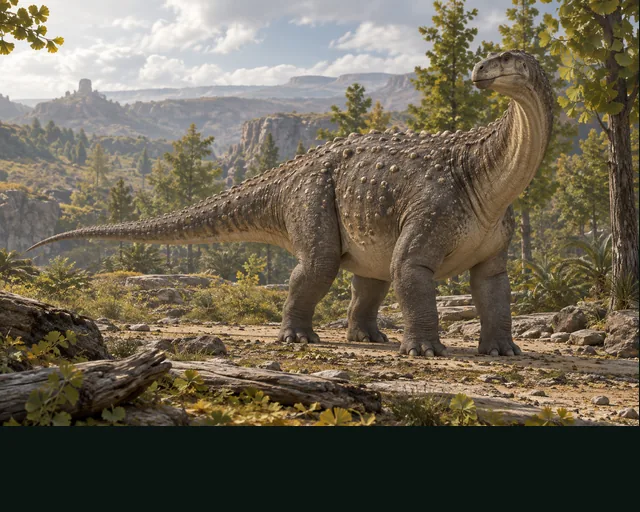
Aegyptosaurus is classified as a herbivore, meaning a plant eater. The reviewed sources do not identify an exact favourite plant. Our AI image uses the museum’s complete Aegyptosaurus restoration as its anatomical reference. The curved neck, curled tail posture and reconstructed body outline follow that artwork; they are not newly verified anatomical measurements. Skin colour and scenery are illustrative choices.
Compare Saltasaurus, explore another Egyptian discovery in Spinosaurus, or browse names beginning with A.
Quick answers
- What does Aegyptosaurus mean?
- Egyptian lizard.
- How long was Aegyptosaurus?
- The Natural History Museum lists about fifteen metres. It is a reconstruction estimate rather than a complete-body measurement.
- What happened to its fossils?
- Much of the known material was destroyed during the Second World War.
- Was Aegyptosaurus a meat eater?
- No. It is classified as a plant-eating sauropod.