Jurassic Dinos editorial · Updated · Source-based review
A duck-billed dinosaur with an unusual shoulder
Adynomosaurus arcanus was a lambeosaurine hadrosaur, a member of the crested duck-billed dinosaur group. Its Late Cretaceous fossils were found in the southern Pyrenees of Spain. The most useful clue to its identity is not a spectacular crest: it is the shape of its shoulder blade.
Albert Prieto-Márquez and colleagues described the animal in 2019. They compared it with other hadrosaurs and identified a scapula, or shoulder blade, whose blade expanded relatively little. The scapula is a bone associated with the shoulder, not the upper arm itself.
Does its name mean it was weak?
The name refers to a proposed consequence of that unusual shoulder shape. The researchers discussed reduced effectiveness of particular muscles attached around the shoulder. This is a specific anatomical interpretation, not a verdict that the entire dinosaur was weak.
Muscles work with bones, joints and attachment sites. A narrow attachment region can raise a question about how a limb moved, but a fossil does not preserve a strength test. Imagine comparing two tools with different handles: the difference matters, yet it does not tell you everything either tool can do.
What was its home like?
The original paper placed Adynomosaurus on the Ibero-Armorican island of the European archipelago. An archipelago is a group of islands. This geographical setting differs from a map of modern mainland Europe, so present-day country borders are useful location labels rather than a picture of its ancient world.
The Catalan Institute of Palaeontology also lists Adynomosaurus among discoveries associated with the Conca Dellà museum and the Dinosaurios de los Pirineos project. Local collections and field records help connect individual bones to the wider history of this region.
How did it fit among other duck-billed dinosaurs?
The original analysis did not settle every branch of its family tree. It left several early lambeosaurine relationships unresolved. An unresolved branch means the available comparisons do not confidently favour one arrangement; it does not mean that all the animals are identical.
Its hadrosaur relationships support a plant-eating interpretation. This account does not assign an exact adult size or favourite food where the reviewed sources leave those details uncertain.
Is the illustrated crest established by fossils?
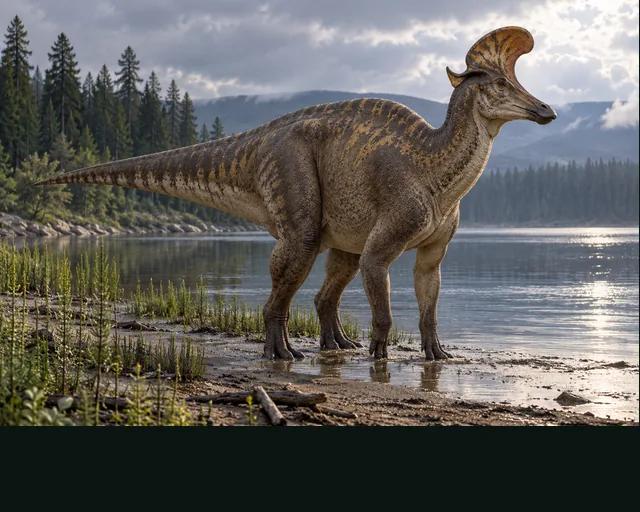
No complete appearance is established by the shoulder diagnosis. Our image follows Connor Ashbridge’s full-body Adynomosaurus restoration. Its crest, colours and soft tissues are reconstruction choices. The shoulder evidence explains identification; the artwork offers a possible living appearance.
Continue with Lambeosaurus, Iguanodon, and the A–Z directory under A.
Quick answers
- What was Adynomosaurus?
- A lambeosaurine duck-billed dinosaur from the Late Cretaceous of Spain.
- Which bone distinguishes it?
- Its scapula, or shoulder blade, has a relatively unexpanded blade compared with other hadrosaurs in the original description.
- Was the entire animal weak?
- That is not established. The name refers to an interpretation of particular shoulder muscles, not whole-body strength.
- Did it live on an island?
- The original study places its region within the Ibero-Armorican island of the ancient European archipelago.