Jurassic Dinos editorial · Updated · Source-based review
A dinosaur named for a missing crest
Adelolophus was a plant-eating duck-billed dinosaur from Late Cretaceous Utah. It belonged to the lambeosaurines, the hadrosaur group famous for elaborate head crests. Yet its own crest is unknown. The name Adelolophus, meaning “unknown crest,” captures a useful puzzle: a jaw can help identify a dinosaur even when the top of its head is missing.
Terry Gates and colleagues named Adelolophus hutchisoni in 2014 from an isolated upper-jaw bone, or maxilla. The specimen is catalogued as UCMP 152028. It is not a skull with a complete crest, and it does not tell us the animal’s full height or length.
How can one jaw be informative?
The maxilla helps form the upper tooth-bearing part of the face. Its overall shape and the arrangement of its surfaces can be compared with the same bone in other hadrosaurs. The original description used such comparisons to recognise a new lambeosaurine.
Imagine identifying a bicycle from a distinctive frame joint when its wheels are missing. You may recognise something important about the design without knowing the colour of its paint. In the same way, identifying a fossil bone does not justify filling every gap with certainty.
Where did Adelolophus live?
Its fossils come from the Wahweap Formation near Death Ridge in southern Utah. In 2016, Patricia Holroyd and J. Howard Hutchison clarified the collection locality and placed it low in the formation’s upper member, using the terminology of that study. Checking field records changed how precisely researchers could place the discovery.
The same locality produced fish, including gar, bowfin and sturgeon relatives, as well as turtles and other dinosaurs. These finds help reconstruct the wider community. They do not prove that all those animals met on a single day, or that Adelolophus itself lived permanently in water.
What would it have eaten?
Its placement among hadrosaurs supports a plant-eating interpretation. However, the reviewed material does not provide a preserved meal or a list of favourite plants. A missing part of the fossil record should remain a question, rather than become a colourful but unsupported menu.
Why show a crest in the artwork?
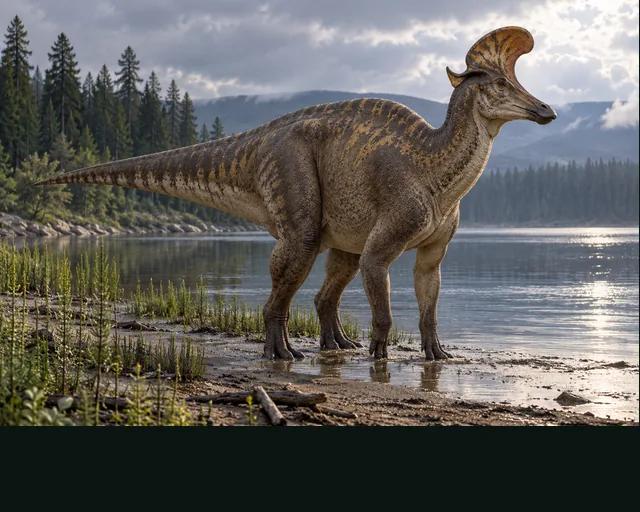
The illustration follows Connor Ashbridge’s complete restoration specifically labelled Adelolophus hutchisoni. The crest shape is the artist’s proposal, as are the missing body proportions and colours. We keep that uncertainty visible in the caption. This is a possible appearance of a poorly known animal, not a newly discovered complete skeleton.
For better-known examples of crested duck-billed dinosaurs, visit Parasaurolophus and Lambeosaurus, or explore names beginning with A.
Quick answers
- What was Adelolophus?
- A lambeosaurine duck-billed dinosaur from the Wahweap Formation of Utah.
- Was its crest found?
- No. The defining fossil is an incomplete upper-jaw bone, so the crest in our illustration is speculative.
- What did Adelolophus eat?
- A plant-eating diet is inferred from its hadrosaur relationships; no exact menu is established here.
- How large was it?
- The reviewed isolated jaw does not establish a measured complete adult length. This page does not assign a precise size.