Jurassic Dinos editorial · Updated · Source-based review
What makes Adasaurus unusual?
Adasaurus was a dromaeosaurid, one of the dinosaurs often called raptors, from Late Cretaceous Mongolia. Its foot challenges a familiar picture of these animals. Instead of an enormous second-toe claw, Adasaurus had a much smaller one. A raptor does not need to match a movie silhouette to belong to this family.
The species Adasaurus mongoliensis was described by Rinchen Barsbold in 1983. Its name combines a Mongolian word associated with an evil spirit and the Greek word for lizard. That dramatic name describes a human naming choice, not evidence that the animal was especially aggressive.
Where were its fossils found?
The defining specimen came from Bugin Tsav in the Nemegt Formation of southwestern Mongolia. Barsbold described an incomplete skull and other parts of the skeleton. These remains provide several parts of the animal to compare, although they do not preserve a complete living outline.
An incomplete skull is still useful. Researchers can match the shapes of individual bones and their connections, rather than judging identity from a general resemblance. A later review by Turner and colleagues retained Adasaurus as a distinct dromaeosaurid and included the reduced second-toe claw among its diagnostic features.
Did the smaller claw work differently?
The claw is only one part of a moving toe. In a 2019 study, Peter Bishop noted that Adasaurus retained the specialised joint shapes associated with a toe that could bend upward, even though its claw was reduced. Think of a door: the handle and the hinge are separate structures. Changing one does not automatically remove the movement allowed by the other.
That study modelled Deinonychus, not a complete Adasaurus leg. Its results therefore cannot establish exactly how Adasaurus caught food. Testing this animal would require its own anatomical assumptions and comparisons. We should not turn a smaller claw into a confident story about a particular hunting technique.
What did it eat, and how large was it?
A predatory feeding role fits its dromaeosaurid relationships, but the sources reviewed here do not identify a preserved meal. They also do not provide a securely measured complete adult body. We leave a precise length and prey list unset rather than attach familiar raptor numbers to a different animal.
Why does the illustration have feathers?
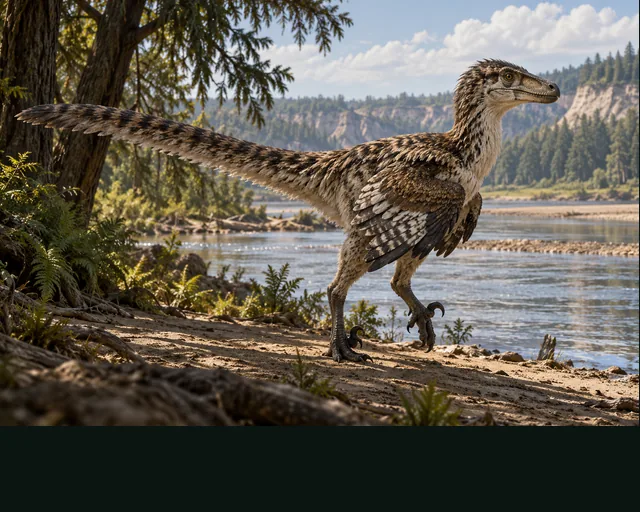
Our artwork follows PaleoNeolitic’s complete, named Adasaurus restoration. The feather coat, colours and soft-tissue outline are features of that restoration, not a photograph of preserved plumage on the defining specimen. The picture and the fossil description answer different questions: one offers a possible appearance, while the other explains the evidence.
Explore Deinonychus, Velociraptor, and the A–Z directory under A.
Quick answers
- Where did Adasaurus live?
- Its defining fossils came from the Late Cretaceous Nemegt Formation of Mongolia.
- Did Adasaurus have a giant sickle claw?
- Its second-toe claw was reduced, although the toe retained specialised joint shapes.
- Was Adasaurus a raptor?
- Yes. It is a dromaeosaurid; a large second-toe claw is not the only feature used to identify that group.
- Are its feathers directly preserved?
- The feathered full-body image is an artistic restoration. The defining fossils do not establish the complete feather coat shown here.