Jurassic Dinos editorial · Updated · Source-based review
What was Adamantisaurus?
Adamantisaurus was a titanosaur, one of the long-necked sauropod dinosaurs, from Late Cretaceous Brazil. Its name comes from the Adamantina Formation. The animal is a reminder that the tail can hold enough distinctive information to name a dinosaur even when a complete skull and skeleton are unavailable.
What did the original description study?
Rodrigo Santucci and Reinaldo Bertini described Adamantisaurus mezzalirai in 2006. Their account centred on six connected vertebrae from the front of the tail and two bones from underneath it, also called haemal arches or chevrons. “Articulated” means that bones remain joined in their natural sequence.
A connected series helps researchers compare how features change along a tail. Looking at one isolated vertebra can be harder: some differences may reflect its position rather than a different kind of animal. Keeping the sequence makes that comparison more informative.
What makes those tail bones distinctive?
The researchers described broad joint surfaces and distinctive shapes in the bony projections rising above the vertebrae. These features were compared with other titanosaurs, including Aeolosaurus. The resulting relationship analysis was not fully resolved, so resemblance should not be presented as proof of a particular direct ancestor.
The scientific task is to compare combinations of traits. One similar projection can be useful evidence, but a classification normally weighs many characters rather than selecting a single convenient match.
How big was it, and what did it eat?
Titanosaurs were plant-eating sauropods, so herbivory is the broad feeding interpretation used here. The original tail material does not reveal the plants chosen by this individual, its feeding height or a daily food requirement.
We leave exact length and mass unspecified. A series of tail bones can support a named taxon without independently establishing complete-body dimensions. Estimating the rest requires assumptions that need their own explanation and source; a model’s apparent size is not a measurement of the extinct animal.
Why use a model as the image reference?
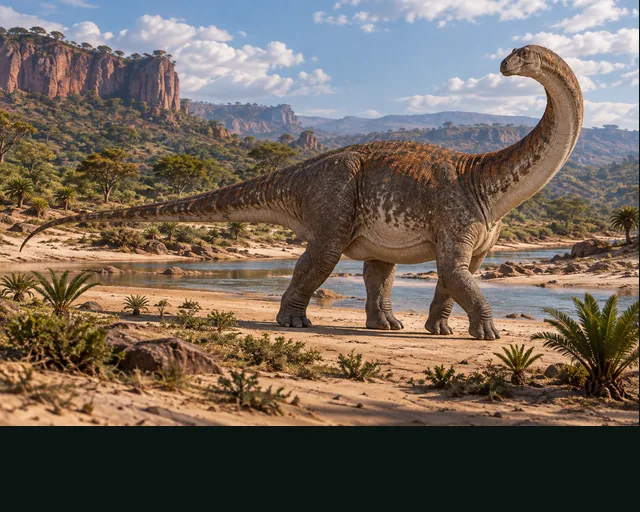
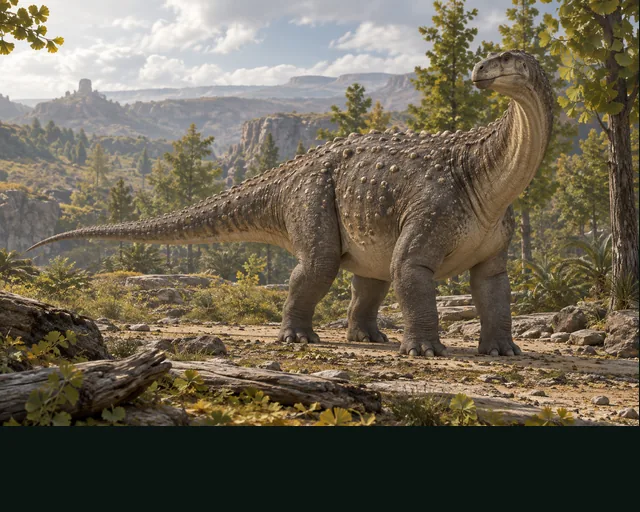
Our source record includes a complete, target-named reconstruction model. The AI artwork follows its visible proportions and limb arrangement, while placing the animal in an independently designed scene. The model is an artist’s interpretation, especially for parts not represented in the original description. Its skin texture, colour and posture are not additional fossil discoveries.
Compare the titanosaurs Saltasaurus and Rapetosaurus, or continue through names beginning with A.
Quick answers
- Where was Adamantisaurus found?
- The original material comes from the Adamantina Formation in Brazil’s Bauru Basin.
- What bones did its description use?
- Six connected front-tail vertebrae and two bones beneath the tail formed the basis of the description.
- How long was Adamantisaurus?
- The reviewed original material does not establish a precise whole-body length.
- Is its model a complete fossil?
- No. The reference is an explicitly named restoration model; unpreserved parts and skin details remain interpretations.