Jurassic Dinos editorial · Updated · Source-based review
What was Acristavus?
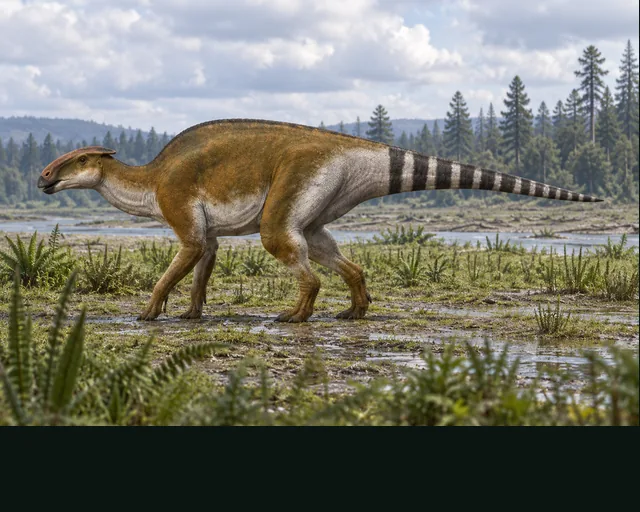
Acristavus was a duck-billed dinosaur from Late Cretaceous North America. Its most memorable feature is something it lacked: the conspicuous skull decoration that makes many other hadrosaurs easy to recognise. A plain-looking head can be scientifically informative, because identifying an animal depends on anatomy rather than how spectacular it appears.
Where were its fossils found?
The 2011 description brought together material from Montana and Utah. The Utah record comes from the Wahweap Formation, including the Grand Staircase-Escalante region. These finds allowed researchers to compare the animal across more than one locality rather than relying on a picture of a single skull.
A locality records where fossils were collected, while a formation identifies their rock context. Keeping both is important. Two specimens from the same modern state need not be the same age; two from different states may still be useful comparisons if their anatomy and geological setting agree.
How can a dinosaur without a crest be identified?
Terry Gates and colleagues named Acristavus gagslarsoni from distinctive features of skull and lower-jaw bones. These include the frontal, a bone in the skull roof, the postorbital near the eye, and the dentary of the lower jaw. Identification therefore rests on a combination of details, not simply the absence of a decorative crest.
The study placed Acristavus in Brachylophosaurini with Brachylophosaurus and Maiasaura. A clade is a group linked by evolutionary ancestry. Such a grouping does not mean that every animal inside it looked identical or lived at exactly the same time.
What did it eat?
Acristavus is interpreted as a plant-eating hadrosaur. Its broad-mouthed appearance should not be confused with a modern duck’s biology: “duck-billed” describes a resemblance in head shape. It does not establish swimming habits, a bird-like diet or the sound the animal made.
We do not give a precise body mass or maximum speed here. The reviewed evidence is strongest for identity and skull anatomy, and a confident-sounding number would not improve an answer without a checked basis.
What is uncertain in the reconstruction?
The AI hero follows the credited, complete Acristavus reference in our source record. Its main constraint is the unornamented head, together with the visible body, limbs and tail. Colour, soft-tissue details and scenery are interpretive. No crest is added merely to make the animal more dramatic.
Compare Maiasaura and Brachylophosaurus, or browse the A directory.
Quick answers
- Did Acristavus have a large crest?
- It is notable for its unornamented head, rather than a large display crest.
- Where are its fossils from?
- The original description includes material from Montana and Utah in the western USA.
- How is a plain-headed dinosaur identified?
- A combination of skull-roof, eye-region and lower-jaw features distinguishes it.
- Was Acristavus related to Maiasaura?
- The original analysis grouped both with Brachylophosaurus in Brachylophosaurini.