Jurassic Dinos editorial · Updated · Source-based review
What was Acantholipan?
Acantholipan was an armoured dinosaur from northeastern Mexico. It belonged to the nodosaurids, a branch of the ankylosaur group. The species Acantholipan gonzalezi was named in 2018 from fossils in Coahuila. Its discovery added a named Mexican animal to a group better known from other parts of North America.
Where and when did it live?
The original research places the animal in the Pen Formation during the Late Cretaceous. A later review discusses a Santonian age around 85 million years ago. Different catalogue summaries do not always use the same stage assignment, so the broad Late Cretaceous label is the safest headline here rather than an artificially precise date.
A formation is a named body of rock recognised by geologists. It supplies the context for a fossil: not just where someone dug, but which sediments enclosed the animal’s remains. Comparing formation names and ages helps avoid mixing animals that lived in the same modern country at very different times.
Which parts have been found?
The described material is incomplete. Published accounts include vertebrae, limb fragments and an armour spine. An osteoderm is a piece of bone that develops within the skin. Finding one shows that the animal had bony armour, but it does not reveal the complete arrangement of every plate across its back.
This distinction is especially important for Acantholipan. A complete restoration must make choices about armour placement and soft tissues. Those choices can be useful for education, but a row of spikes in an image is not automatically a row preserved in the fossil.
Did it have a tail club or eat meat?
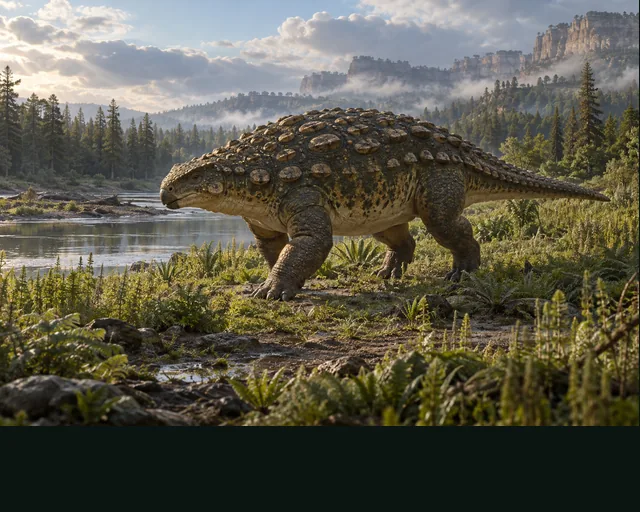
Our approved complete-body reference shows a tapering tail without a club. We preserve that feature instead of adding the famous club associated with animals such as Ankylosaurus. Acantholipan is interpreted as a plant-eater, even though its armour looks formidable. Defensive-looking structures do not by themselves indicate a predatory diet.
The fossils also do not establish a particular combat move, a maximum running speed or a daily feeding routine. Those are tempting storytelling details, but they would go beyond the evidence checked for this page.
How was our image made?
The AI hero follows SpinoDragon145’s target-named, complete Acantholipan restoration. The low body, four limbs, full tail and visible armour follow that reference. The exact armour layout, colours and surrounding vegetation remain artistic interpretations. No missing whole-body image was invented from a skeleton.
Compare Nodosaurus and Ankylosaurus, or browse names beginning with A.
Quick answers
- Where did Acantholipan live?
- Its described remains come from the Pen Formation in Coahuila, northeastern Mexico.
- What is an osteoderm?
- It is a piece of bone within the skin, forming part of an animal’s armour.
- Is the whole armour pattern known?
- No. The fossils are incomplete; the exact plate arrangement in the illustration remains interpretive.
- Does this reconstruction have a tail club?
- No. It follows the approved complete reference, which depicts a tapering tail without a club.