Jurassic Dinos editorial · Updated · Source-based review
What was Abrosaurus?
Abrosaurus was a sauropod dinosaur from the Jurassic rocks of Sichuan, China. Its scientific story begins with an unusually well-preserved skull from Dashanpu. Whereas some dinosaurs are named from scattered limb or tail bones, this animal gives researchers a particularly useful look at the head of a long-necked plant-eater.
Why does its skull matter?
Ouyang Hui’s 1989 description, available in a Smithsonian-hosted translation, reports a skull collected in 1984. The type specimen is ZDM5038 at the Zigong Dinosaur Museum. A type specimen is the physical example used to anchor a scientific name, so later comparisons have something concrete to refer back to.
The description emphasises delicate bony supports, large openings and numerous broadly spoon-shaped teeth. Openings in a skull are not simply damage: many are normal anatomical features. Their position, shape and boundaries can help researchers compare dinosaurs. Teeth also carry information about feeding, although their shape cannot identify every plant an animal ate.
Was a complete body described?
The original paper focuses on the skull and states that the bones behind the head were not yet excavated for that account. It does not provide a complete, measured body for the artist to copy. We avoid presenting a precise adult length or weight here because the inspected original description does not establish those figures.
That distinction is useful when looking at any dinosaur picture. A skull can be exceptionally complete while the body’s proportions are less secure. “Well preserved” needs an object: well-preserved teeth, a well-preserved skull and a well-preserved whole skeleton are different claims.
Why do sources spell the species name differently?
The original description used dongpoensis. Modern catalogues and overviews commonly use dongpoi. The name honours the Chinese writer Su Dongpo. Historical spellings can remain visible in old paper titles even when later authors use a corrected form; they do not automatically represent different dinosaurs.
What does the illustration add?
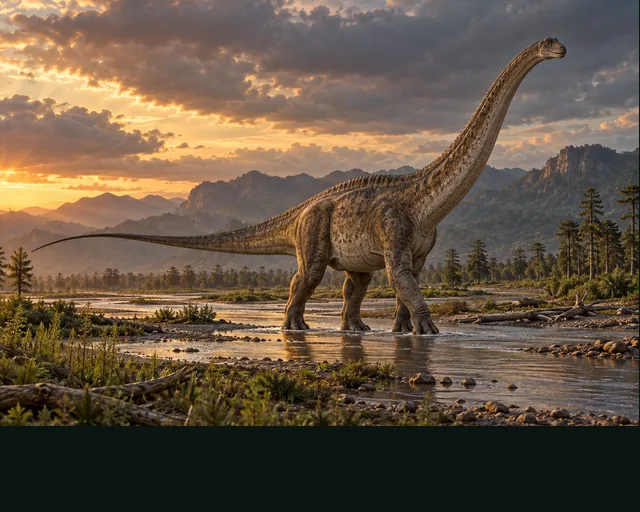
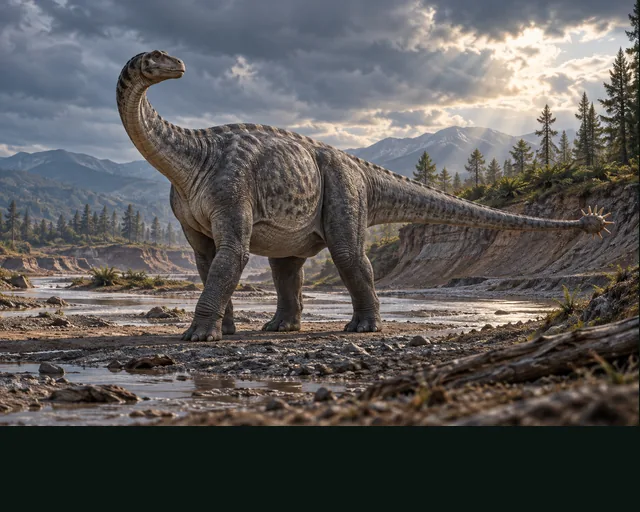
Our AI hero follows Leví Martínez-Reza’s complete, explicitly named Abrosaurus restoration. It retains the small head, tall curved neck, four-legged body and long tail visible in that reference. The image is an interpretation, especially for unpreserved soft tissues, colours and the surrounding landscape. It supplies an accessible introduction without turning artistic detail into anatomical evidence.
To place this animal among other sauropods, explore Shunosaurus and Omeisaurus. You can also browse dinosaur names beginning with A.
Quick answers
- Where was Abrosaurus found?
- Its original skull comes from Dashanpu, Sichuan, China.
- What is distinctive about Abrosaurus?
- The original description highlights a delicate skull with large openings and numerous spoon-shaped teeth.
- Does its original description include a complete skeleton?
- No. It focuses on the skull and says postcranial bones had not yet been excavated for that account.
- Why are there two species-name spellings?
- The original title used dongpoensis; later references commonly use dongpoi. Different spellings do not necessarily identify different animals.