Jurassic Dinos editorial · Updated · Source-based review
What was Abditosaurus?
Abditosaurus was a large, plant-eating sauropod from what is now Catalonia in Spain. Its long neck and four-legged build place it among the familiar sauropod giants, but its scientific importance lies in a geographical puzzle: why was such a large titanosaur living in the island landscapes of Late Cretaceous Europe?
The species Abditosaurus kuehnei was described in 2022. Its name is often translated as “forgotten lizard”, a reminder of the long history between the first discovery and the eventual scientific description.
Where and when did it live?
The fossils come from the Orcau-1 locality in the southern Pyrenees. The research announcement dates the specimen to about 70.5 million years ago. That is an estimate for the fossil’s geological setting, rather than a calendar date for when this particular animal was born.
The modern Pyrenees should not be imagined as an unchanged backdrop stretching back through time. Researchers study ancient rocks and their position to reconstruct the landscape in which an animal lived. Today’s place name tells us where to find the fossils; it does not by itself describe their original environment.
Why did its size surprise researchers?
The university announcement estimates a length of nearly 18 metres and a mass of roughly 14 tonnes. These are reconstructed dimensions, not measurements of a living animal. Other European titanosaurs were generally smaller, making this specimen useful for studying differences between island dinosaur communities.
A size estimate combines preserved evidence and a reconstruction. Two animals can both be called titanosaurs and still differ substantially in proportions or size. Our article therefore attaches the estimates to Abditosaurus and its published study, without treating them as a standard size for all members of the group.
What does it tell us about travel between continents?
The original research placed Abditosaurus with titanosaurs showing southern-continent affinities, rather than simply grouping it with the smaller European forms. This supports a history involving connections between regions. It is evidence from relationships and geography, not a record of an individual dinosaur’s journey or swimming ability.
What remains uncertain in the picture?
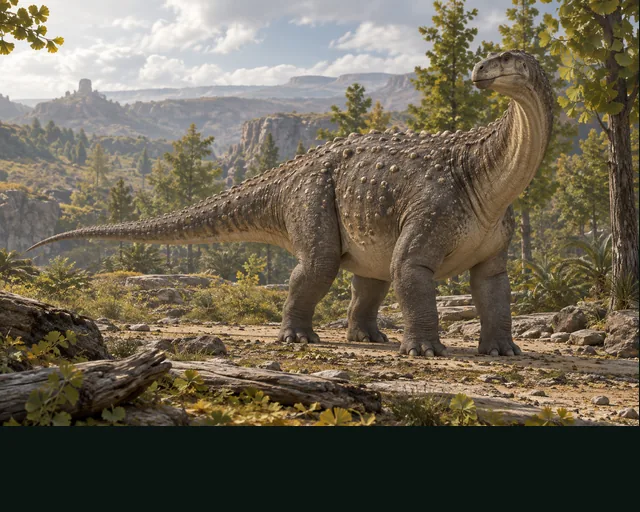
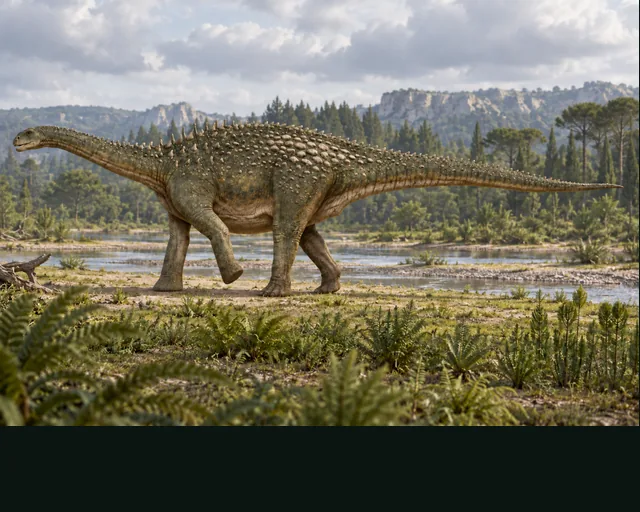
The AI hero uses the complete Abditosaurus restoration credited to SpinoDragon145 as its appearance reference. Skin colours, lighting and scenery remain artistic. A detailed picture should not be confused with preserved colour evidence or a photograph of this animal.
Compare Ampelosaurus and Saltasaurus, or explore more names starting with A.
Quick answers
- Where did Abditosaurus live?
- Its fossils were found at Orcau-1 in what is now Catalonia, Spain.
- When did Abditosaurus live?
- The research announcement dates the specimen to about 70.5 million years ago.
- How big was Abditosaurus?
- The institutional announcement estimates nearly 18 metres long and roughly 14 tonnes; these are reconstruction estimates.
- What did Abditosaurus eat?
- It was a plant-eating sauropod. Its precise daily menu is unknown.