Jurassic Dinos editorial · Updated · Source-based review
What was Abdarainurus?
Abdarainurus was a long-necked sauropod dinosaur from Mongolia. Scientists named it in 2020 after studying an unusual collection of tail bones from the Late Cretaceous Alagteeg Formation. A sauropod is a member of the dinosaur group that includes four-legged, long-necked plant-eaters such as Diplodocus. Abdarainurus is especially interesting because its known tail does not fit neatly into an already familiar picture of sauropod relationships.
What fossils identify this animal?
Alexander Averianov and Alexey Lopatin described several vertebrae from the front of the tail, one from farther along it, and chevrons. Vertebrae are the separate bones of the backbone; chevrons are bones underneath the tail. The researchers recognised a distinctive combination of shapes, ridges and hollows in this material.
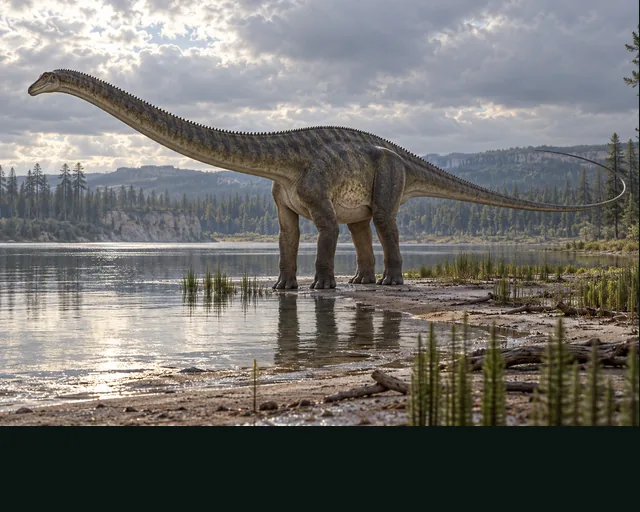
These fossils are enough to investigate identity, but they are not a complete skeleton. No head-to-tail measurement follows directly from the material described in that study. We therefore leave an exact length and mass unfilled instead of converting the size of an illustration into a fact.
Which dinosaurs were its relatives?
The original authors preferred a position near the early branches of the titanosaurs, while warning that incomplete knowledge could affect their result. A 2024 study of the Chinese dinosaur Gandititan also placed Abdarainurus among titanosaurs and paired those two genera in its evolutionary tree.
An evolutionary tree is a testable explanation of relationships. It compares anatomical characteristics across animals; adding fossils or changing the comparison can change its branches. The newer result supports a connection, rather than proving that one animal was the direct ancestor of the other.
What did it eat?
Plant eating is the broad interpretation associated with its sauropod identity. The tail bones do not reveal a particular favourite plant, feeding height or daily quantity of food. Those narrower questions require other evidence, so a detailed menu would give a misleading impression of certainty.
How should I read the reconstruction?
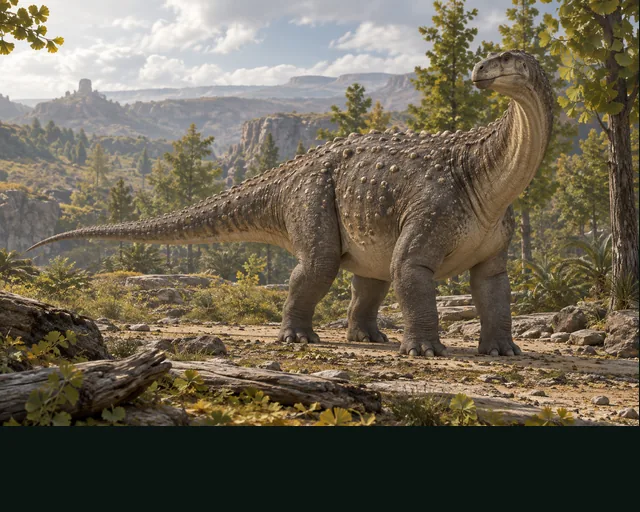
Our AI illustration follows Levi Martinez-Reza’s named, complete Abdarainurus restoration. The reference artist explicitly reconstructed unpreserved parts through comparisons. We retain that limitation: the small head, long neck and body outline are a published artistic interpretation, not newly discovered fossils. The colours and landscape are illustrative choices. We do not use isolated bones to invent a different complete animal.
Explore Diplodocus for another sauropod, read about Saltasaurus, or return to the A–Z names beginning with A.
Quick answers
- Where was Abdarainurus found?
- The described fossils come from the Alagteeg Formation in Mongolia.
- Is a complete Abdarainurus skeleton known from the original description?
- No. That account describes tail vertebrae and chevrons, not a complete animal.
- How large was Abdarainurus?
- The material reviewed here does not establish a reliable complete-body length or mass.
- Was Abdarainurus a titanosaur?
- The original authors preferred that relationship with qualifications; a 2024 analysis also placed it among titanosaurs.