Jurassic Dinos editorial · Updated · Source-based review
What was Spinostropheus?
Spinostropheus gautieri was a theropod dinosaur from the Tiouaren Formation of Niger. Its remains have been discussed in studies of early ceratosaur relationships, and the genus was established in a 2004 reassessment of material historically given another generic assignment. Its story illustrates how the age of surrounding rocks can change the interpretation of a dinosaur’s evolutionary importance.
Why do some older sources mention the Cretaceous?
Earlier accounts placed the formation in the Early Cretaceous, and the title of the 2004 research reflected a broader mid-Cretaceous framework. A 2009 reassessment found that the previously cited fish, invertebrate and geological evidence did not securely support that age. It proposed a Jurassic context instead.
Later research discussing additional theropod material recognised a latest Middle Jurassic interpretation as a geological proposal. We use the broader Jurassic label here without pretending that every local layer has an exact direct date. The year in which a paper was published and the geological age proposed inside it are also different kinds of dates.
Where does it fit among theropods?
The reviewed studies discussed alternative positions for Spinostropheus, including an early ceratosaur or a basal abelisauroid under different analyses. These hypotheses concern which combinations of anatomical characters support a particular branch of the family tree.
They do not mean that every theropod found in the same formation is Spinostropheus. A new jaw, tooth or skeleton needs its own identification before its features can be transferred into this account. Shared geography is useful context, but it is not a substitute for an anatomical match. This is particularly important when a familiar named animal is represented by incomplete remains.
How should we interpret its reconstructed appearance?
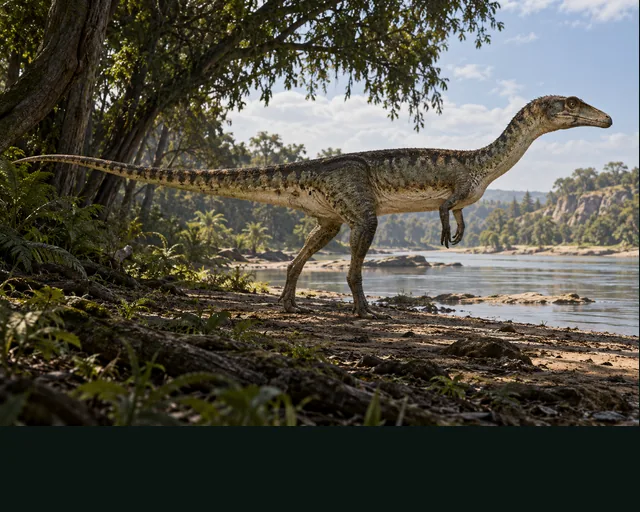
Our picture follows a complete living Spinostropheus artwork by Nobu Tamura. It supplies an interpreted long low head, short grasping forelimbs, long hindlegs and tapering tail. The whole-body reference, rather than photographs of vertebrae or other isolated bones, guided the new illustration.
That does not establish a complete preserved skull, precise adult proportions or a known skin pattern. Fine surface details, colour and the floodplain clearing are artistic, and the illustrated pose is not evidence of a specific hunting event. Compare Elaphrosaurus and Ceratosaurus for separate early ceratosaur accounts, then browse the S directory.
Quick answers
- Where was Spinostropheus found?
- The Tiouaren Formation of Niger.
- Why do older sources mention the Cretaceous?
- They followed an older age interpretation later reassessed.
- Is its exact narrow family placement fixed here?
- No. Different analyses have placed it differently among early ceratosaurs.
- Is the complete illustrated head directly preserved?
- The approved whole-body artwork is highly restored and should not be read as a complete discovered animal.