Jurassic Dinos editorial · Updated · Source-based review
What was Spicomellus?
Spicomellus afer was an armored ankylosaur from Middle Jurassic Morocco. It became known through an unusual spiked rib, leading to its naming in 2021. Additional discoveries, reported in 2025 after new excavation, revealed a much more elaborate animal than that first isolated bone could show.
Why were its spikes so unusual?
The Natural History Museum explains that some spikes were fused directly to underlying bones, including ribs. Armor in many other animals sits within the skin instead. Spicomellus also had a bony neck collar carrying very long spikes. Together, these structures made it an extraordinary example of early ankylosaur armor.
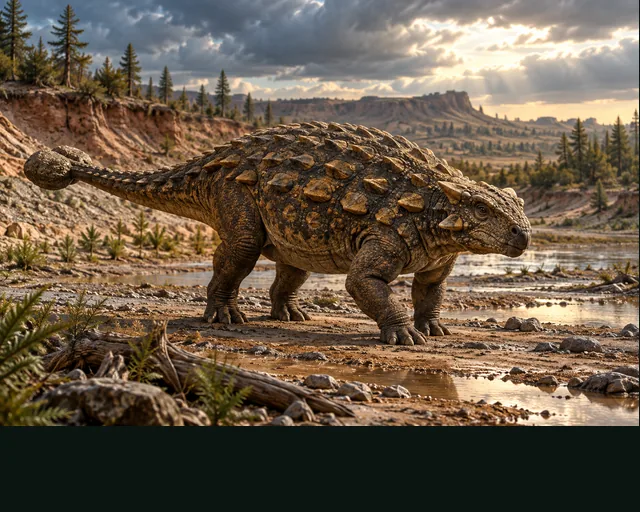
That combination raises questions as well as answering them. Reconstructing how muscles and skin fitted around unusual bones requires care. The museum’s researchers explicitly acknowledge uncertainty about aspects of movement. Our standing illustration should therefore not be treated as a measured demonstration of its complete walking mechanics.
Do we know the exact tail weapon?
The surviving tail material includes a stiffened structure interpreted as a handle, supporting the hypothesis of a terminal weapon. However, the museum account states that the actual tail end has not been found. Evidence for a weapon and a complete preserved weapon are different things.
Our image follows the current complete museum artwork, including its spiked tail interpretation. That supplies a visual possibility rather than a claim that the exact terminal outline is known. We do not replace the missing end with a generic Ankylosaurus club, or describe a specific striking motion as an observed behaviour.
Was armor only useful for protection?
The 2025 research discussion considered display as well as defense. A conspicuous structure could potentially have communicated information between animals, but possible roles need testing. A dramatic-looking spike does not by itself prove a particular mating display or combat event.
The new picture preserves the approved reference’s low body, four supporting limbs, collar, flank armor and projecting spikes. Colours, skin and exact missing parts are artistic. It was generated from that complete living reference, not extrapolated from the rib or skeletal diagrams. Compare Ankylosaurus and Pinacosaurus for other armored dinosaurs, then visit the S directory.
Quick answers
- Where did Spicomellus live?
- Morocco during the Middle Jurassic.
- What made its spikes especially unusual?
- Some were fused directly to underlying bones, including ribs.
- Was its complete tail tip found?
- No. A tail weapon is inferred from surviving structures.
- Were its spikes definitely only for defense?
- No. Researchers also considered display as a possible role.