Jurassic Dinos editorial · Updated · Source-based review
What was Skorpiovenator?
Skorpiovenator bustingorryi was an abelisaurid theropod from the Huincul Formation near Villa El Chocon in Patagonia, Argentina. Abelisaurids were predatory dinosaurs with body plans distinct from the familiar northern tyrannosaurids. A detailed 2026 skull study provides new comparisons for understanding this animal and its relatives.
Why is its skull important?
The researchers described a particularly well-preserved skull and used CT-assisted work to investigate its anatomy. Their account characterises it as moderately short and tall, with strongly ornamented facial bones. Ornamented bone surfaces are anatomical observations; they do not independently determine the exact colours or thickness of the missing skin.
CT scanning can help examine preserved internal structures and connections. It does not transform a fossil into a photograph of a living animal. Here the study supports written facts about the skull. It was not used as an image prompt to invent a missing full exterior.
Why does this page avoid one precise age?
The skull paper uses the traditional Cenomanian-Turonian context, within the Late Cretaceous. A separate 2026 geological study reported older, Albian zircon ages from volcanic ash beds in the Huincul and underlying Candeleros formations. Its authors argued that these results require reconsidering the timing of important fossil assemblages.
Those are conflicting published contexts that need to remain visible. A formation-level age from a sampled ash bed is not automatically the exact age of this individual dinosaur. Connecting dated layers, local rock successions and the fossil’s position is part of the geological work. We therefore retain the broad Cretaceous label without hiding the newer proposal or presenting an exact number as settled.
What does the restored animal show?
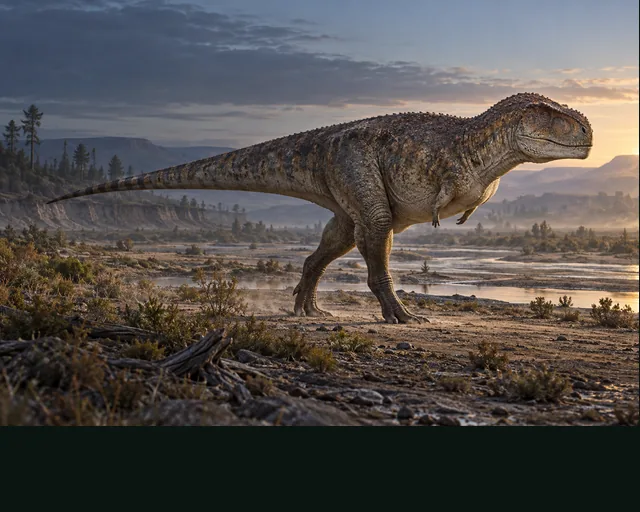
Our picture follows a complete living Skorpiovenator artwork by Nobu Tamura, preserving its deep head, reduced forelimbs, strong hindlegs and long tail. Low back contours, missing soft tissues and colours are features of the artistic interpretation. No scorpion meal or direct hunting event is claimed from the image.
This is also why the skull study and the picture have different roles: one documents fossil anatomy, while the other provides a clearly labelled visual reconstruction. Compare Carnotaurus and Abelisaurus for other abelisaurids, then explore the S directory.
Quick answers
- Where was Skorpiovenator found?
- The Huincul Formation of Patagonia, Argentina.
- What kind of dinosaur was it?
- An abelisaurid theropod predator.
- Is its exact age treated as settled here?
- No. Recent geological dating conflicts with the traditional age context.
- Are skin details directly established by a skull study?
- No. The full living image remains a separate artistic reconstruction.