Jurassic Dinos editorial · Updated · Source-based review
What was Sinotyrannus?
Sinotyrannus kazuoensis was a large tyrannosauroid dinosaur from Early Cretaceous northeastern China. The reviewed research places its fragmentary remains in the Jiufotang Formation of Liaoning. Named in 2009, it showed that some early members of the broader tyrannosaur lineage had already achieved substantial size long before the last Cretaceous giants.
Is a tyrannosauroid the same as a tyrannosaurid?
No. Tyrannosauroidea is the broader evolutionary branch, while Tyrannosauridae is a narrower family that includes Tyrannosaurus rex. Similar-looking scientific terms can therefore describe quite different amounts of a family tree. Membership in the larger branch does not automatically establish membership in the smaller one.
A 2016 analysis grouped Sinotyrannus with proceratosaurids rather than the later tyrannosaurids. The authors interpreted the familiar giant tyrannosaur body plan as developing in stages. Their results did not place every large early predator on a single direct path leading to T. rex.
Why does an incomplete skeleton affect size estimates?
The original material includes fragmentary skull and body remains. A technical review discussed large total-length estimates based on that incomplete evidence. Estimating a whole animal from selected parts involves comparisons and assumptions about its proportions, rather than simply laying a complete specimen beside a tape measure.
Different reconstructions can therefore give different results even when they use the same fossil. This account avoids a precise maximum length or a largest-ever headline. Large size is interesting evidence about the group’s history without requiring a competition whose ranking depends on uncertain reconstructions.
What does the illustration show?
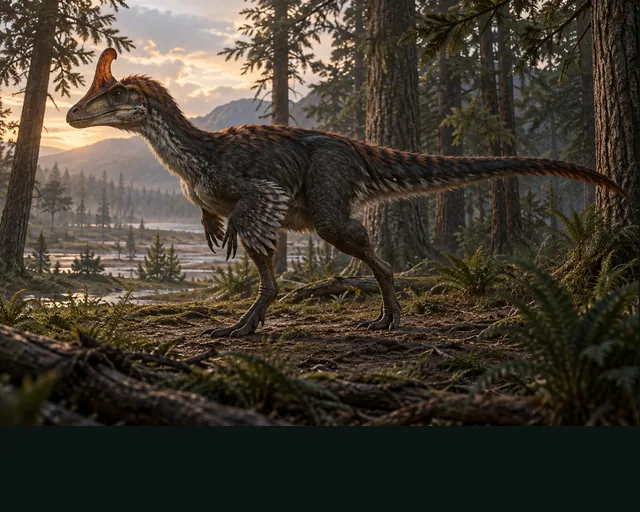
Our image follows a complete living restoration specifically identified as Sinotyrannus kazuoensis. It retains the reference’s low elongate snout, substantial body, grasping forelimbs, strong hindlegs and long tail. It does not replace that reference with a generic T. rex silhouette or borrow another genus’s body merely because a relationship has been proposed.
Its feathered covering is an interpretation in the artwork, not direct evidence reported here for a preserved Sinotyrannus coat. Colours and the woodland scene are also artistic. Compare Tyrannosaurus and Guanlong as separately sourced relatives, then explore the S directory for more accounts of the broader dinosaur family tree.
Quick answers
- Where did Sinotyrannus live?
- Liaoning in northeastern China during the Early Cretaceous.
- Was a complete body found?
- The described evidence includes fragmentary skull and body material.
- Does its large size make it a tyrannosaurid?
- No. The reviewed analysis placed it on an earlier tyrannosauroid branch.
- Are the illustrated feathers directly confirmed here?
- No. They belong to the approved complete artistic restoration.