Jurassic Dinos editorial · Updated · Source-based review
What was Sinornithosaurus?
Sinornithosaurus millenii was a dromaeosaurid theropod from Early Cretaceous China. The original 1999 description reported material from the Yixian Formation at Sihetun. Its importance goes beyond looking like a small predator: its body covering helped connect evidence about non-avian dinosaurs with questions about the evolution of feathers.
What was its covering like?
The describing study reported a filamentous integument. Integument means the body’s outer covering; filamentous describes slender threadlike structures. These observations provided evidence that dromaeosaurids had coverings more complex than the entirely bare, lizardlike skin often shown in older popular pictures.
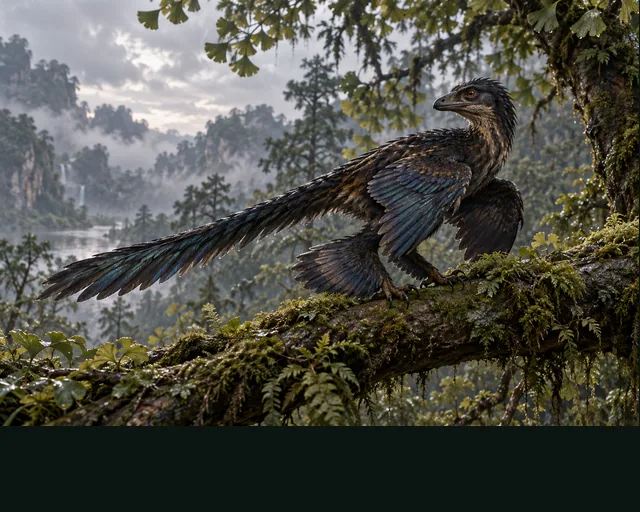
That does not make every visible feather in a modern painting a directly preserved feature. Length, distribution and fine appearance need their own evidence. Our complete museum reference includes broad forelimb plumage and a feathered tail end. We retain those as elements of that named artistic restoration rather than treating the image itself as a newly discovered fossil.
Did feathers mean it could fly?
Not automatically. Feathers can be considered separately from powered flight. A structure may have several possible roles, and investigating the evolution of a flight-related body plan does not establish that every animal sharing some of its features could take off and fly.
The original description discussed birdlike features of the body skeleton in an evolutionary framework. Such comparisons are hypotheses about relationships and anatomical change. They should not be rewritten as an observed flight performance for the fossil individual, or as a promise that every detail of an older family-tree analysis remains unchanged.
Was it a venomous dinosaur?
A later proposal suggested a venom-delivery system, but a reassessment found no unambiguous support. The authors explained that apparently elongated teeth could reflect displacement from their sockets after death. They also noted that tooth grooves occur in other theropods, so a groove alone does not demonstrate venom.
We therefore show neither poison nor snake-style fangs and do not describe a venomous attack as established behaviour. The generated image follows a complete living Sinornithosaurus reference, with colours and scene clearly interpretive. Compare Microraptor and Velociraptor for separately sourced relatives, then visit the S directory to explore more feathered dinosaurs.
Quick answers
- Was Sinornithosaurus feathered?
- The original study described filamentous body covering.
- Where did it live?
- Early Cretaceous China, with the described material from the Yixian Formation.
- Was it definitely venomous?
- No. A reassessment found no unambiguous venom-delivery evidence.
- Do feathers prove it could fly?
- No. A covering and the ability to perform powered flight are different questions.