Jurassic Dinos editorial · Updated · Source-based review
What was Scolosaurus?
Scolosaurus cutleri was an armored ankylosaurid dinosaur from the Late Cretaceous Dinosaur Park Formation of Alberta, Canada. It belongs to the broad plant-eating armored dinosaur radiation. Its history is useful for learning why two fossils can look broadly similar yet still deserve separate names after detailed comparison.
Why was the name reconsidered?
For decades, Scolosaurus was commonly treated as a synonym of Euoplocephalus. A synonym in this setting is a different scientific name judged to represent the same animal taxon. Such decisions are interpretations of the available evidence, and later researchers can test them again.
A 2013 reassessment argued that Scolosaurus cutleri was distinct. The authors compared its remains with material attributed to Euoplocephalus and Dyoplosaurus. They did not base their conclusion on a different paint scheme or the dramatic appearance of a modern illustration. The important evidence came from anatomical structures that could be compared between specimens.
What kinds of features were compared?
The study highlighted differences in cervical half-rings, osteoderms and forelimb anatomy. Cervical refers to the neck. Osteoderms are bony structures formed in the skin, contributing to an animal’s external armor. A half-ring describes an arrangement of armor around part of the neck rather than an ordinary backbone vertebra.
The authors also distinguished pelvic armor from that of Dyoplosaurus. The pelvis is the hip region. These comparisons show why identification requires more than noticing that an animal has a broad body and defensive spikes. Position, shape and combinations of features all matter, as does knowing which specimen supplied each observation.
Is every detail in the picture known?
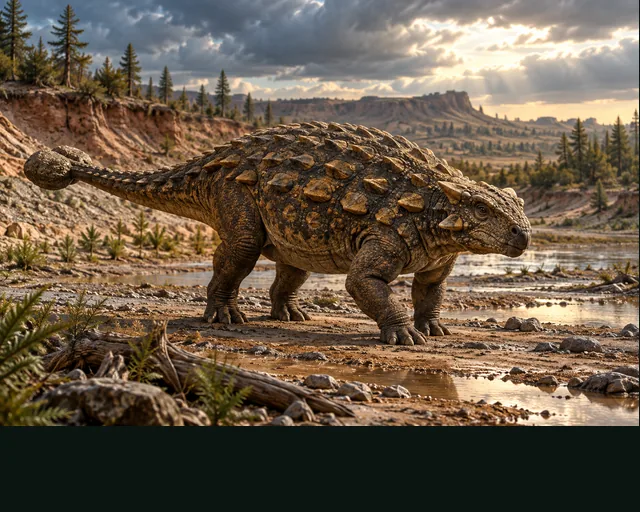
Our illustration follows a complete living restoration labelled Scolosaurus, with a low head, broad four-legged body, patterned armor and a terminal tail club. That reference supplies the artistic whole-body interpretation; this article does not claim that one fossil preserves every illustrated structure together.
The exact colours, small skin details, missing armor arrangement and scene remain interpretive. The first generated version was rejected because its club met the frame edge; the accepted version keeps the entire tail tip visible. That image review checks presentation and reference fidelity, rather than independently proving paleontological accuracy. Compare Ankylosaurus and Pinacosaurus, then visit the S directory for more separately sourced accounts.
Quick answers
- Where did Scolosaurus cutleri live?
- The region now called Alberta, Canada, during the Late Cretaceous.
- What are osteoderms?
- Bony structures that form within the skin.
- Was its name always treated as distinct?
- No. It was long grouped with Euoplocephalus before reassessment.
- Does the illustration establish every armor position?
- No. Some details belong to the complete artistic restoration.