Jurassic Dinos editorial · Updated · Source-based review
What was Sarcosaurus?
Sarcosaurus woodi was a carnivorous theropod from Early Jurassic England. Its name means flesh lizard. The fossil record is incomplete, but a modern revision shows how returning to familiar material can clarify both the number of species represented and their place in early theropod evolution.
Why were several specimens reconsidered?
Three specimens from central England had been assigned to two names, Sarcosaurus woodi and Sarcosaurus andrewsi. The 2020 revision redescribed one important specimen, WARMS G667-690, in detail and reassessed the wider collection. The authors argued that the three specimens represent a single valid species, S. woodi.
They treated S. andrewsi as a subjective junior synonym. Subjective means the decision rests on an anatomical taxonomic judgement rather than the names sharing exactly the same name-bearing specimen. Junior identifies the later name in the comparison. This explains the historical wording without creating duplicate pages for the same proposed species.
Where did the analysis place it?
The study recovered Sarcosaurus close to Averostra, the branch including ceratosaurs and tetanurans. This is more careful than simply copying an older narrow classification label into every modern account. A family-tree result should be linked to the analysis supporting it, especially for an incompletely known early dinosaur.
Being close to a branching point does not prove that the species itself was the direct ancestor of all later animals on those branches. It identifies a comparative evolutionary position. Additional material and different datasets can continue to test that interpretation.
What was actually preserved?
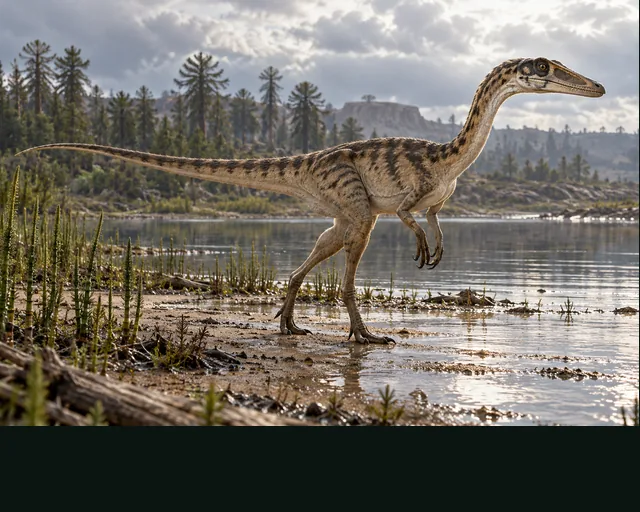
The Natural History Museum lists partial pelvic material, a femur and vertebrae. The pelvis is the hip region, while the femur is the thigh bone. Those remains do not directly preserve the detailed head visible in our illustration.
The new picture follows a complete living museum restoration specifically labelled Sarcosaurus, including its interpreted elongated face, grasping forearms, long hindlegs and tail. It was not generated by inventing a body from the pelvic fossils. Skin, colour, low head contours and missing soft tissues remain artistic. Compare Coelophysis and Ceratosaurus as separate theropod accounts, then explore the S directory for other discoveries and their sources.
Quick answers
- Where did Sarcosaurus live?
- The region now known as central England.
- Were two species retained in the revision?
- The authors supported one valid species, S. woodi.
- What happened to S. andrewsi?
- The study treated it as a subjective junior synonym.
- Is the restored head a discovered skull?
- The museum account lists body material; the head in our image remains a reconstruction.