Jurassic Dinos editorial · Updated · Source-based review
What was Pyroraptor?
Pyroraptor olympius was a small carnivorous dinosaur from Late Cretaceous Europe. The Natural History Museum records it from France and Spain and discusses it as a dromaeosaur. Its name means fire thief, a reference to the circumstances of discovery rather than evidence that it lived in flames.
How did a forest fire enter the story?
The museum explains that remains were first discovered after a destructive forest fire in Provence, France. Events that expose a fossil site can become part of a scientific name. They do not necessarily describe the animal’s own habitat preferences or behaviour millions of years earlier.
Only a limited collection of small bones and teeth is known. That is enough to make the discovery interesting while leaving much of the complete living appearance uncertain. A curved toe claw does not independently reveal the exact head, feather pattern or total adult dimensions.
Was it the same animal as Variraptor?
The relationship between the two names has been debated. A 2009 reassessment of French dromaeosaurid material found that newly available specimens did not resolve the possible synonymy. The authors nevertheless considered the evidence compatible with the existence of two valid taxa.
Synonymy means that two scientific names refer to the same taxon. Demonstrating it requires diagnostic comparisons, not merely finding both names in the same region. This page therefore retains Pyroraptor while explaining the uncertainty instead of silently declaring the question settled.
Could it dive like the movie animal?
A fictional underwater pursuit is not a record of dinosaur behaviour. The museum discusses the difficulty of establishing swimming abilities from the available evidence and does not confirm prolonged underwater diving for Pyroraptor. A possibility shared with many land animals is different from a demonstrated specialised lifestyle.
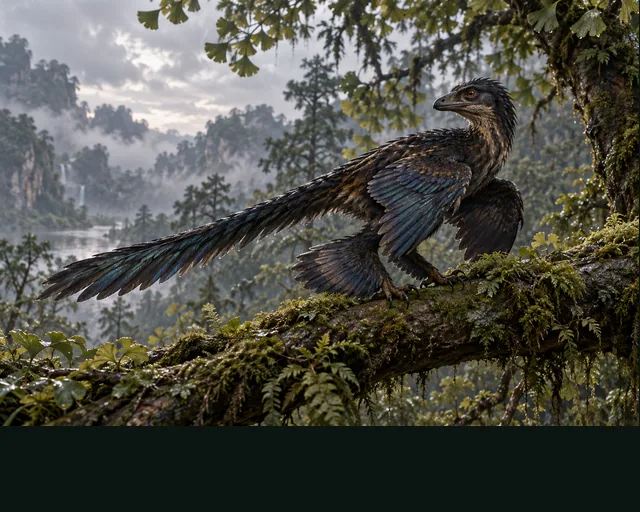
Our new scene keeps the animal on visible dry ground and follows an approved complete living restoration, rather than a film or game character. It shows a feathered neck and torso, folded forelimbs, long hindlegs and narrow tail. The covering, colours and restored proportions remain artistic interpretations; the few known fossils do not preserve that entire outline. Compare Velociraptor and Microraptor for separate dromaeosaur accounts, then explore the P directory.
Quick answers
- What does Pyroraptor mean?
- Fire thief, referring to the discovery history rather than a fire-related adaptation.
- Is its whole body known from fossils?
- No. The museum stresses the small amount of material.
- Is it proven to be the same as Variraptor?
- The reviewed reassessment did not resolve the proposed synonymy.
- Does its movie role demonstrate deep diving?
- No. Fictional behaviour is not fossil evidence.