Jurassic Dinos editorial · Updated · Source-based review
What was Pycnonemosaurus?
Pycnonemosaurus nevesi was a carnivorous abelisaurid from Late Cretaceous Brazil. Abelisaurids were a widespread group of theropod predators in the southern continents. A revised description identifies it as the first abelisaurid originally described from Brazil’s Bauru Group, placing its discovery within a broader regional fossil record.
Why revise the original description?
The 2017 study reconsidered its anatomy after additional abelisauroid discoveries had improved the available comparisons. It also described three additional transverse processes from tail vertebrae. A transverse process is a projection extending sideways from a vertebra, rather than a separate horn or skin spike.
New comparisons can make an old specimen more informative. A feature once difficult to assess may become clearer when researchers have a wider range of related animals to examine. That does not mean every newly described relative’s bones should be transferred into the original animal’s fossil record.
Which parts helped distinguish it?
The revision highlighted features of the pubis, tail vertebrae and tibia. The pubis is one of the main pelvic bones, while the tibia forms part of the lower leg. The combination of these features contributed to distinguishing Pycnonemosaurus from other abelisaurids.
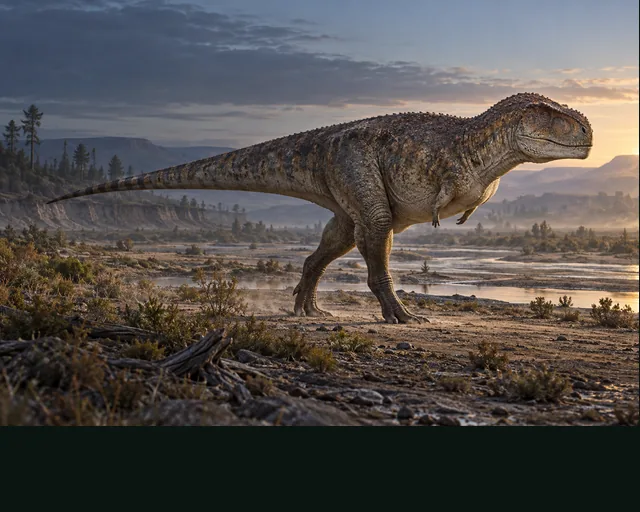
The robust shin bone is relevant to its powerful-looking hindlimb reconstruction, but the new exterior was not invented from a fossil photograph. Our image follows a separately approved complete living artwork specifically labelled Pycnonemosaurus. Its restored skull, extremely small arms and skin retain the uncertainty of that reference.
Was the discovered individual fully grown?
The revised study noted unfused sutures as signs of skeletal immaturity, while leaving the precise developmental stage uncertain. A suture is a connection between bones. Its condition can provide information about growth without automatically giving an exact birthday or a guaranteed final adult size.
For that reason, this account does not enlarge the specimen into a precisely measured adult or repeat a permanent largest-ever ranking. Comparisons of incompletely known predators depend on methods and new discoveries. The illustration’s colour, head ornament and soft tissues remain artistic. Compare Carnotaurus and Abelisaurus for separate abelisaurid accounts, then visit the P directory for more names and their sources.
Quick answers
- Where did Pycnonemosaurus live?
- The region now called Brazil.
- Was it an abelisaurid?
- Yes. The revised study supports its placement with derived abelisaurids.
- What does the tibia refer to?
- A main shin bone in the lower leg.
- Is the specimen at a precisely known growth stage?
- No. The study notes signs of immaturity but retains uncertainty about the exact stage.