Jurassic Dinos editorial · Updated · Source-based review
What was Parksosaurus?
Parksosaurus was a small plant-eating dinosaur from Late Cretaceous Canada. A recent anatomical study places its fossils in the early Maastrichtian part of the Horseshoe Canyon Formation in Alberta. The genus name honours Parks, connecting the animal with the history of Canadian dinosaur research.
Why study a skeleton collected long ago?
The known skeleton was collected in 1922, but that did not end the discovery process. A detailed account published in 2023 followed extensive additional preparation of the specimen. Preparation removes surrounding rock and exposes features that may previously have been hidden or difficult to examine.
New information can therefore come from an existing museum specimen rather than a new excavation. Better access to a bone’s surface can improve comparisons and help researchers test older interpretations. This work also makes the evidence easier for other scientists to assess through more detailed descriptions and illustrations.
What does the known material include?
The study discusses a skull and much of the associated body skeleton, together with an isolated referred tooth. Associated material found with a skeleton and a separately referred fossil are different categories of evidence. They should not be combined into an imaginary record of many complete individuals.
Postcranial means behind the skull. Describing those bones in detail helps researchers compare body features as well as faces. This matters for a small dinosaur whose wider relationships among neornithischians have been debated. We retain that broad ornithischian identity without treating a narrower family-tree position as permanently settled.
Can footprints be assigned with certainty?
The paper discusses tracks that have been tentatively linked to a similar bipedal dinosaur, possibly Parksosaurus. Possibly is an essential qualification. A footprint records contact with the ground, but it does not carry a genus label, and different animals can leave similar-looking traces.
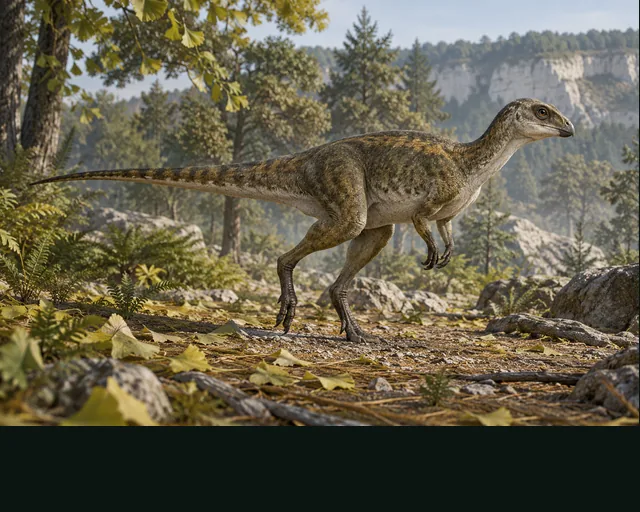
Our picture follows the approved complete Parksosaurus restoration for its small beaked head, short arms, long hindlegs and balancing tail. The calm walking pose is independently composed; it does not demonstrate a measured running speed. Colour and skin pattern remain artistic. Compare Hypsilophodon and Dryosaurus as separate accounts, then explore the P directory. Different historical species spellings are not treated as separate animals or duplicate pages.
Quick answers
- Where did Parksosaurus live?
- Alberta in what is now Canada.
- How does recent research date its fossils?
- The anatomical paper places them in the early Maastrichtian Horseshoe Canyon Formation.
- What did additional preparation accomplish?
- It exposed anatomical details for a renewed description of the known skeleton.
- Do tentatively referred footprints prove their maker?
- No. A possible assignment retains uncertainty.