Jurassic Dinos editorial · Updated · Source-based review
What was Obelignathus?
Obelignathus septimanicus was an ornithopod dinosaur from Late Cretaceous southern France. Its scientific story centres on an unusually robust lower-jaw bone. The material had already been assigned to Rhabdodon septimanicus before a 2025 study argued that it deserved a separate genus.
How can an old fossil receive a new name?
Reclassification does not always follow a new excavation. Researchers can return to an existing specimen, compare it with a wider range of animals and ask whether its original assignment still fits. In this case, the study examined anatomy and measurements of rhabdodontomorph dentaries across several taxa.
A dentary is the main tooth-bearing bone of the lower jaw. Comparing its proportions and features gives more information than simply calling one jaw large or strong. The authors found the specimen sufficiently unusual to support the new genus Obelignathus, while retaining the species name septimanicus. These historical combinations concern the same taxon rather than two independently discovered dinosaurs.
Why was its jaw so important?
Jaws occur relatively often in the group’s fossil record and preserve useful features for comparisons. The study used multivariate methods, which examine several measurements together instead of treating one number as the entire answer. Its result helps illustrate how variation among European ornithopods can be tested rather than judged only by visual impression.
The genus name refers to Obelix, the strong character from the Asterix comics, together with the Greek word for jaw. That playful reference concerns the robust specimen; it does not mean the dinosaur had a cartoon character’s habits or strength.
What remains uncertain?
The paper stresses the incomplete nature of the type material and the need for further detailed work on European rhabdodontomorphs. A distinctive jaw can support a taxonomic argument without answering every family-tree or whole-body question. It does not directly preserve the animal’s full gait, skin pattern, tail or adult dimensions.
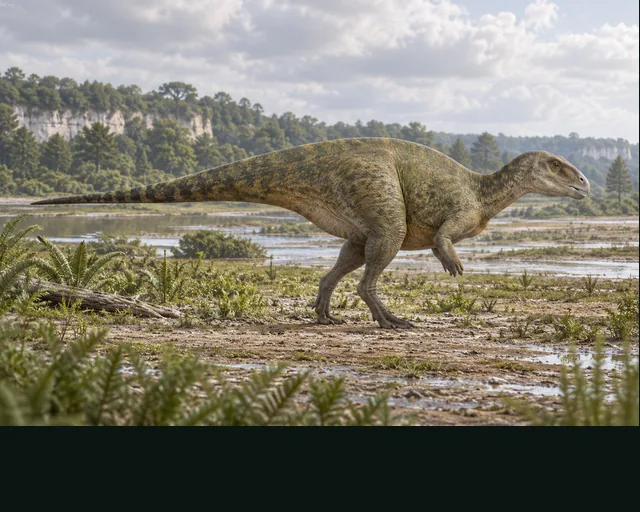
Our illustration therefore follows a reviewed complete Obelignathus artwork for the living outline, including a low beaked head, deep trunk and long tail. The quadrupedal pose and soft tissues belong to that reconstruction, not to a newly inferred exterior from the jaw. Compare Rhabdodon and Iguanodon, then browse the O directory.
Quick answers
- Was Obelignathus newly excavated in 2025?
- The new genus resulted from reassessing an already named jaw specimen.
- What is a dentary?
- The main tooth-bearing bone of the lower jaw.
- What was its previous genus assignment?
- The species was previously called Rhabdodon septimanicus.
- Does the jaw establish its whole exterior?
- No. The living illustration follows a named complete artistic reconstruction with stated uncertainty.