Jurassic Dinos editorial · Updated · Source-based review
What was Niebla?
Niebla antiqua was a carnivorous abelisaurid from Late Cretaceous Patagonia. Its fossils were found in the Allen Formation of Rio Negro Province, Argentina, in rocks assigned to the Maastrichtian stage. Abelisaurids were a diverse branch of theropod dinosaurs, including the better-known Carnotaurus.
Why does maturity matter here?
The original description identified Niebla as smaller than some familiar abelisaurids from the same broad time interval. However, the researchers did not simply assume that its size made it a juvenile. They examined bone tissue, a method called histology, and interpreted the specimen as having reached somatic maturity.
Somatic maturity concerns the growth of the body. This evidence supports a genuinely more moderately sized predator, rather than an animal that necessarily would have grown into a much larger named species. Size and age are related questions, but one cannot always answer the other. A small adult and a large youngster can belong to very different growth stories.
How much of the skeleton was found?
The described material includes a nearly complete braincase, fragments of jaw and teeth, a shoulder-girdle element, ribs and incomplete vertebrae. A braincase is the bony region surrounding the brain. It should not be mistaken for a complete skull, a preserved brain or an entire living head.
Distinctive features of the braincase and shoulder region helped the authors distinguish the animal. The specimen therefore adds information about abelisaurid diversity even though it lacks a complete skeleton. An impressive whole-body picture is an introduction to that evidence, not a replacement for it.
Why is it called mist?
Niebla is the Spanish word for mist. The naming account links it to foggy days during the excavation. The species name antiqua refers to antiquity. This records a memorable part of fieldwork without showing that the dinosaur itself always lived in fog.
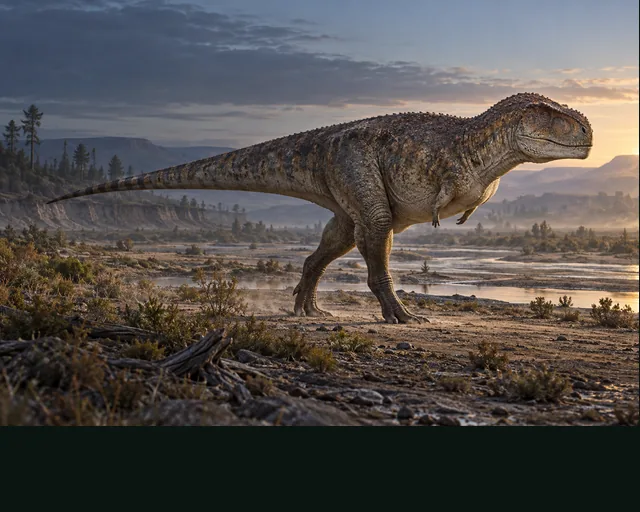
Our illustration follows an approved complete Niebla restoration, with a short deep head, extremely small forelimbs, powerful hindlegs and long tail. It does not borrow Carnotaurus horns or invent large grasping hands. Skin, colour and head ornament remain interpreted. Compare Carnotaurus and Abelisaurus, then browse the N directory.
Quick answers
- Was the known Niebla a baby?
- The original study interpreted its bone tissue as showing somatic maturity.
- Where did its fossils come from?
- The Allen Formation in Rio Negro Province, northern Patagonia.
- Does a nearly complete braincase mean a complete head?
- No. It is only one part of the skull.
- What inspired the genus name?
- The Spanish word for mist recalls foggy days during excavation.