Jurassic Dinos editorial · Updated · Source-based review
What was Montanoceratops?
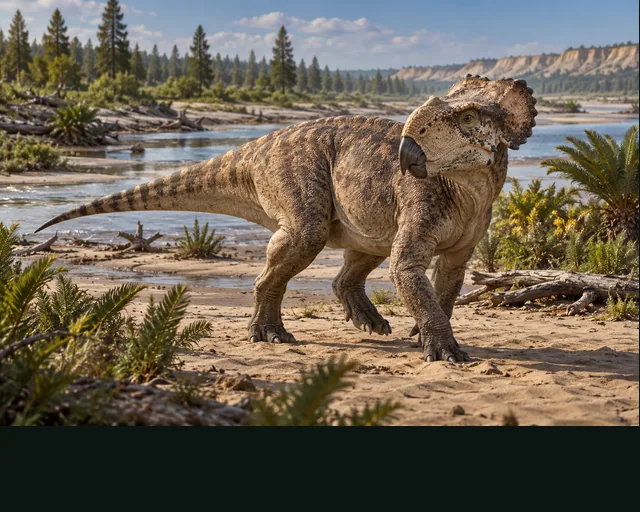
Montanoceratops cerorhynchus was a Late Cretaceous ceratopsian from North America. Ceratopsians are the horned-dinosaur branch of the family tree, but the label does not mean that every member looked like a smaller Triceratops. Our approved living reference depicts a compact animal with a beak, short frill, modest nasal prominence and long tail.
Why did a second specimen matter?
A 1998 study by Brenda Chinnery and David Weishampel described additional material that made the animal easier to compare with other ceratopsians. It included parts of the skull, the shoulder girdle and the hand. The shoulder girdle is the set of bones connecting the forelimbs to the trunk.
More specimens can help because an important feature missing from one skeleton may survive in another. A hand can add information about the forelimb, while a skull fragment answers a different set of questions. Researchers must still establish that the material belongs to the named animal rather than simply combining every fossil from the same region.
What can a braincase tell us?
The additional skull material included the back portion of the braincase. A braincase is bone surrounding the brain, rather than a fossilised brain itself. Its shape and openings can supply anatomical characters for comparisons even when the soft organ has not survived.
This distinction is useful whenever a headline says that researchers studied a dinosaur’s brain region. Sometimes the evidence comes from the surrounding bones or the space they enclosed. That can be informative without preserving the original nervous tissue.
Why can family trees change?
The 1998 paper tested how several early-diverging neoceratopsians and ceratopsids were related. Its proposed arrangement belongs to that study’s evidence and methods. Later catalogues and analyses can use a different selection of specimens or characters, so an older tree should not be presented as the final answer forever.
Our illustration follows a complete restoration specifically identified as Montanoceratops. It does not derive a new exterior from the newly described bones. The colour pattern, skin and precise soft-tissue outline remain artistic interpretations. Compare the separate accounts for Leptoceratops and Protoceratops, then explore the M directory for other names and their individual evidence.
Quick answers
- Was Montanoceratops a horned dinosaur?
- Yes. It belonged to the ceratopsian branch of the dinosaur family tree.
- What did a second specimen add?
- Parts of the skull, shoulder girdle and hand provided additional anatomical information.
- Is a fossil braincase a preserved brain?
- No. It is the surrounding bony part of the skull.
- Does one published family tree settle every relationship?
- No. A tree tests relationships using particular characters and specimens.